September 17, 2026 • Celeste Morrow • 9 min reading time • Prices verified June 6, 2026
Vase-Ready Faux Arrangements: What You're Actually Buying and Whether the Markup Is Worth It
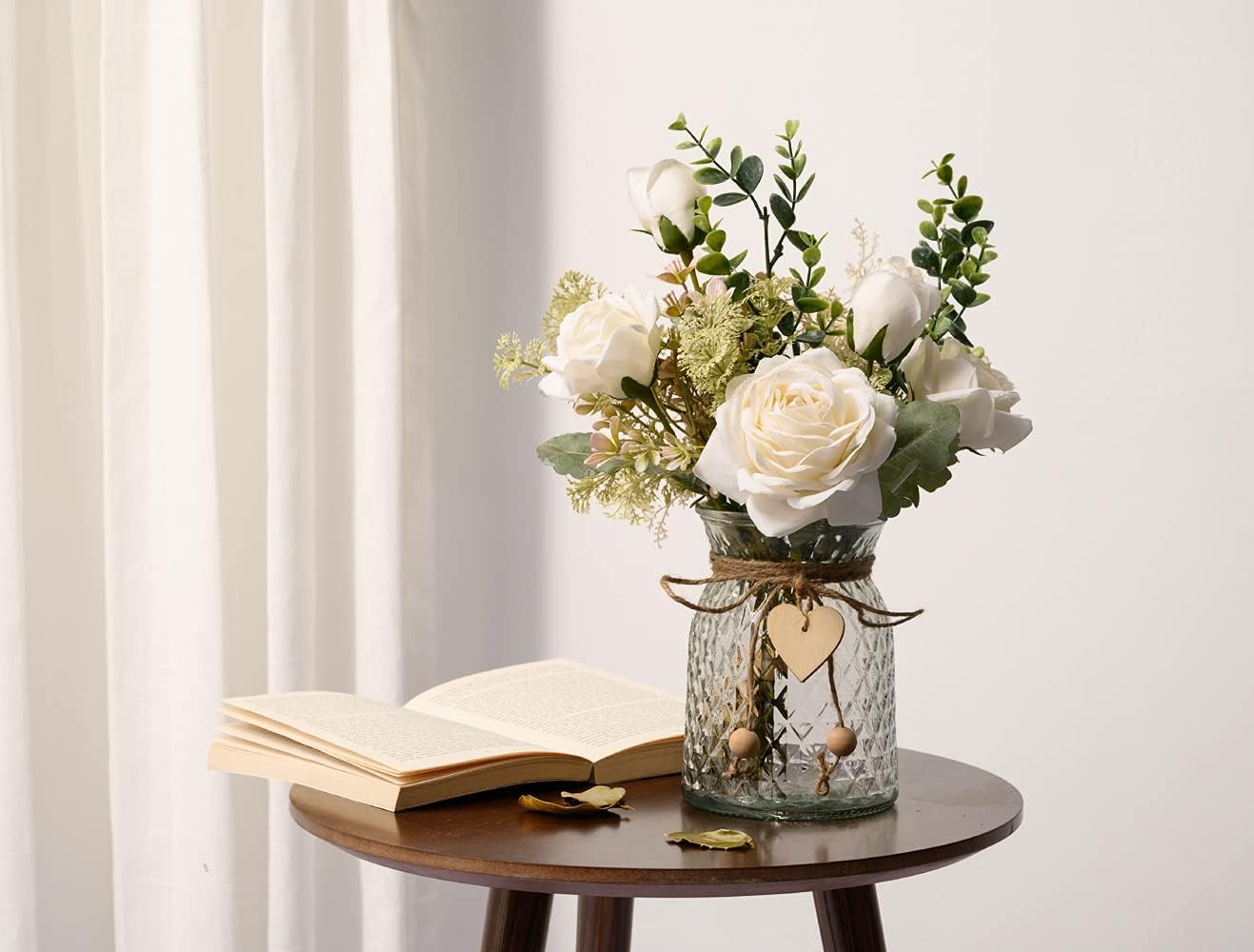
If you’ve ever seen a beautiful floral display on a shelf at a home goods store — flowers already arranged in a vase, looking like someone styled them that morning — you’ve encountered a vase-ready faux arrangement. “Vase-ready” simply means the artificial flowers (stems made from silk, latex, or plastic rather than real petals) come pre-arranged and sold as a complete unit: vessel plus blooms, positioned and proportioned, no assembly required. The appeal is obvious. You lift it out of the box and set it on a table. But the price range runs from $25 at a mass-market retailer to $600+ from a specialty brand, and the gap between what those numbers actually deliver is genuinely confusing — even for buyers who’ve been in this space for a year or two. This guide breaks down exactly what you’re paying for at each tier, where the markup is justified, and where you’re just paying for packaging.
| EDITOR'S PICKBLOSMON Fake Flowers in Vase fo… | Mid-tierYJ Fake Flowers with Vase | Budget pickWracra Hydrangeas Floral Arrang… | |
|---|---|---|---|
| Flower type | Mums + eucalyptus | Roses | Hydrangeas |
| Stem count | 12 | — | — |
| Vase material | Metal | — | Glass |
| Flower material | Faux silk | Silk | Silk |
| Color | White | White | Blue |
| Price | $31.31 | $26.99 | $21.65 |
| See on Amazon → | See on Amazon → | See on Amazon → |
What the Price Is Actually Buying (Layer by Layer)
When you see a dramatic price difference between two vase-ready arrangements that look similar in a product photo, the money is distributed across four distinct components. Understanding each one separately is how you avoid overpaying — or underpaying when it matters.
1. The vessel itself. The container is frequently 30–45% of the total cost in mid-to-premium arrangements. A mercury glass urn, a hand-thrown ceramic cylinder, or a matte concrete plinth from a European studio carries material and production cost independent of what’s in it. At the $25–$60 range, the vase is almost always a lightweight cast resin or thin-walled glass equivalent — usable, but not a design object on its own. Architectural Digest’s roundup of designer-recommended faux florals consistently distinguishes brands that source distinct vessels versus those using commodity containers, noting that the vessel quality is often what separates a “looks great in the showroom” arrangement from one that reads well at arm’s length in a residential install.
2. Stem material and petal construction. This is where realism lives. The three materials you’ll encounter most often:
- Polyester silk (sometimes listed as “polysilk”): The industry standard at the $40–$150 range. Soft to the touch, decent color saturation, but petal edges can look uniform and slightly stiff under close inspection.
- Real-touch latex (also called “PE” or polyethylene coating): A softer, more translucent outer layer that mimics the slight irregularity of a living petal. Standard in arrangements from brands like Winward Silks and Afloral’s upper tier. House Beautiful’s faux flower coverage notes that real-touch construction is the most consistent realism marker cited by interior designers across aggregated product reviews.
- Preserved botanicals: Not artificial in the traditional sense — these are real flowers that have undergone a glycerin-based preservation process to halt decay and maintain pliability. Venus ET Fleur and Primrose London work primarily in this category. Preserved arrangements have a tactile and visual authenticity that no manufactured petal fully replicates, which partly explains the $300–$800 price points for their boxed arrangements.
3. Arrangement labor and styling. Pre-arranging flowers sounds trivial, but skilled floral staging — varied stem heights, natural clustering, realistic droop and lean in bloom heads — takes real time. Budget arrangements are typically machine-positioned or assembled to a template. Premium brands either hand-position in-studio or design arrangements tight enough that the “formula” is proprietary. This labor cost is embedded in the markup and it’s legitimate. Brides magazine’s coverage of artificial wedding flowers notes that professional florists sourcing pre-made centerpiece arrangements for events are largely paying for this staging consistency — the ability to order twelve identical arrangements and have all twelve look styled rather than factory-assembled.
4. Colorfast and UV-resistance treatment. Faux florals fade. The rate depends on material treatment. High-end manufacturers apply UV-inhibitor coatings that, per published spec language from brands like Winward Silks and Afloral, extend color stability in indirect light conditions to three to five years. Budget polysilk arrangements without this treatment show visible fading in six to eighteen months near a window. For a home decorator rotating seasonals, that may be acceptable. For a hospitality buyer installing arrangements in a lobby atrium or a restaurant with ambient natural light, it is not.
The Markup Tiers, Honestly Scored
Here’s the clearest framing I can offer for the four price bands you’ll encounter in 2026:
By the numbers:
| Price tier | Vessel quality | Stem material | UV treatment | Best use case |
|---|---|---|---|---|
| $25–$60 | Resin / thin glass | Polysilk, minimal coating | Rarely present | Seasonal swap, low-light shelf |
| $60–$150 | Mid ceramics, basic glass | Polysilk or entry real-touch | Sometimes present | Living room, craft event |
| $150–$350 | Distinct ceramics, curated glass | Real-touch latex / PE | Usually present | Residential install, event centerpiece |
| $350–$800+ | Artisan vessel or branded box | Preserved or premium PE | N/A (preserved) or high-spec | Luxury residential, hospitality, high-end events |
The honest read: the $60–$150 tier is where the most confusion lives. Brands in this range vary enormously in actual quality, and product photography is optimized to close that gap visually. Apartment Therapy’s buyer guidance on making faux flowers look real specifically calls out this mid-tier as requiring the most due diligence — reviewers report that arrangements photographed with warm directional lighting can look dramatically different under the cool overhead light of an actual room.
The $150–$350 tier is where the markup starts earning its keep for practitioners. Arrangements in this range, particularly from Afloral’s curated vase collections and Nearly Natural’s upper SKUs, consistently receive reviewer notes about structural integrity over twelve-plus months — stems holding position, petals not flattening — which directly affects per-use cost math for event designers who need arrangements that survive transport, setup, and teardown cycles.
The $350–$800+ tier (preserved arrangements from Venus ET Fleur, Primrose London, and similar) is a genuinely different product category. Preserved roses in a hatbox or luxury cylinder are not competing with silk on realism — they are real flowers. The trade-off is fragility: preserved botanicals respond poorly to high humidity, direct sunlight, and handling, which makes them better suited to controlled residential environments than commercial installs with staff traffic. Brides’ coverage of high-end artificial floral sourcing notes this fragility caveat consistently in the context of event planning.
The Realism Markers That Product Photos Hide
If you’re evaluating a vase-ready arrangement from a product listing rather than in person, here are the specific signals worth hunting for:
Petal edge irregularity. Real petals are not uniform. In product descriptions, phrases like “hand-finished edges,” “natural edge variation,” or “irregular petal shaping” signal that the manufacturer at least acknowledges this. Flat, perfectly consistent petal outlines visible even in warm-lit photos are a reliable indicator of budget polysilk.
Stem wrapping. Look for descriptions of “wire-wrapped stems” or “floral tape wrapping” versus molded plastic stems. Wrapped stems flex and can be repositioned; molded stems cannot. For a vase-ready arrangement this matters less than for loose stems, but it affects how well the arrangement survives shipping and whether a stylist can adjust positioning on-site.
Leaf veining and color variation. Foliage is frequently where budget arrangements reveal themselves. Real leaves have visible vein structures, subtle color gradation (lighter midrib, darker blade), and occasional texture variation. Product photos that show foliage only in soft focus or tight on the blooms are often compensating for flat, monochrome leaves underneath. House Beautiful’s faux flower reviews highlight foliage realism as the single most-cited differentiator in reader responses — more than petal quality.
Water simulation. Some vase-ready arrangements include an acrylic “water” fill — clear resin poured to simulate a water line. This is a meaningful realism upgrade, but quality varies sharply. Reviewers across aggregated listings note that budget acrylic fills yellow within six to twelve months and develop surface cloudiness; premium fills (typically from brands using optical-grade acrylic) remain clear for years. If a listing mentions acrylic water, check whether it specifies material grade or whether reviewers mention yellowing.
The Cost-Per-Use Frame for Practitioners
If you’re placing arrangements for clients — whether that’s a residential install, a boutique hotel, or a recurring event production — the purchase price is the wrong number to anchor on. The more useful frame is cost per year of effective display life, adjusted for use case.
A $75 arrangement that fades noticeably in fourteen months in a well-lit living room costs roughly $64 per year. A $220 arrangement with UV treatment and real-touch construction that holds color and structure for four years costs $55 per year — and requires no replacement conversation with the client. For a hospitality buyer outfitting twelve lobby tables, that math compounds quickly.
For event designers, the relevant variable isn’t longevity — it’s transport durability and reset consistency. Arrangements with flexible wrapped stems, stable vessel bases (weighted or wide-footed), and blooms that don’t shift in a box survive the venue-to-van-to-venue cycle that flat-based decorative vases with glued foam inserts do not. This is where the $150–$350 tier earns the premium for practitioners even if the arrangement is only used twelve times a year.
The Clear Decision Rules
If you’re sitting with a sourcing decision right now, here’s the if/then framework:
If the arrangement is going into a low-light interior (hallway, dining room with ambient light only) and the client rotates seasonally: then the $60–$120 range is the rational buy. UV treatment matters less; realism will read from distance.
If the arrangement is in a sun-adjacent space (near a window, atrium, or exterior-facing retail display): then pay for UV treatment explicitly or expect a replacement within eighteen months. Budget up to the $150–$250 range and confirm UV-inhibitor coating in the spec.
If you’re event designing and need arrangement consistency across multiples: then the $150–$350 tier is your floor. Variability in budget arrangements across units becomes visible when twelve centerpieces are on the same table run.
If the application is luxury residential or a controlled-environment hospitality space and the client brief emphasizes authenticity above all: then preserved botanicals from a brand like Venus ET Fleur or Primrose London are the only product that fully delivers — with the explicit caveat that fragility and handling restrictions need to be communicated to the client upfront.
If the product photo looks great but the listing has no material specs, no reviewer photos, and no mention of UV treatment or stem construction: then treat it as a $25–$60 tier product regardless of the price tag. The information gap is itself a quality signal.
The vase-ready format is genuinely convenient and, at the right tier, genuinely worth the premium. The buyers who overpay are almost always the ones anchoring on the photo rather than the spec — and the ones who underpay are usually the ones who don’t account for how much the replacement cost and the client conversation will cost them later.