September 5, 2026 • Celeste Morrow • 9 min reading time • Prices verified June 6, 2026
Artificial Hanging Baskets and Outdoor Planters: A Complete Setup Guide for Low-Maintenance Porches
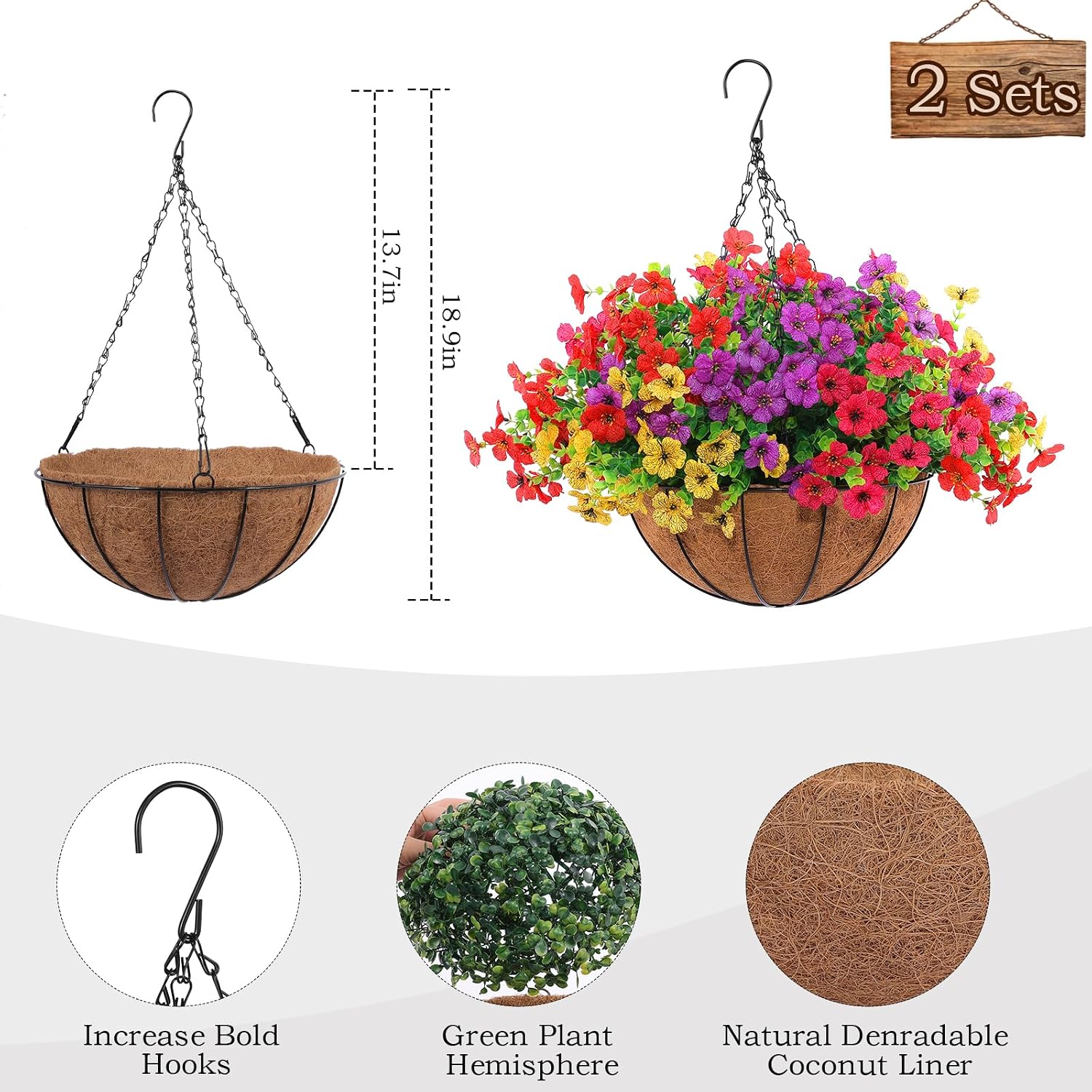
If you’ve ever watched a gorgeous hanging basket of petunias or fuchsias shrivel in July heat despite your best efforts, you’re not alone — and you’re exactly who this article is for. Artificial hanging baskets (also called faux planters — meaning flower arrangements made from silk, polyester, or plastic rather than live plants) have quietly become a serious design tool, not just a novelty. Modern versions use UV-resistant coatings (a surface treatment that slows color fading from sun exposure) and realistic petal texturing that can genuinely fool a passerby at five feet. This guide walks through everything from picking the right product for your specific porch conditions to the hands-on setup techniques reviewers swear by — including a stem-trimming trick that turns a flat bundle into a convincingly full basket. By the end, you’ll have a clear decision framework and a realistic sense of what these products can and can’t do.
Why Faux Outdoor Planters Actually Make Sense Now
The story reviewers tell, across dozens of aggregated product reviews, is remarkably consistent: they switched after one too many failed growing seasons. Full western or southern exposures, apartment balconies with no irrigation access, rental properties where watering schedules aren’t reliable — these are all conditions where even experienced gardeners lose the battle. The Spruce’s coverage of artificial outdoor plants notes that UV-stabilized synthetics have improved dramatically in the past five years, with premium polysilk and real-touch latex options holding color through multiple seasons when maintained correctly.
That context matters when you’re calibrating your expectations. A $12 bundle of compressed silk petunias and a $60 pre-built UV-rated basket are both “artificial flowers,” but they perform very differently. The material categories worth knowing:
- Polysilk / fabric silk: The most common. Woven polyester stretched over wire frames. Good drape, moderate UV resistance unless specifically treated.
- Real-touch latex / PE (polyethylene): Molded rather than stitched; heavier, more three-dimensional, substantially more convincing up close. PE is the standard in higher-end outdoor lines.
- Preserved botanicals: Real dried or glycerin-treated plant material — not a fit for full outdoor exposure; fades and absorbs moisture.
For outdoor hanging baskets specifically, you want UV-resistant polysilk at minimum, and PE or latex-coated petals if the basket will sit in direct afternoon sun for six-plus hours.
Choosing the Right Product for Your Exposure and Setup
This is the decision most buyers get wrong. They optimize for color or flower type and underbuy on UV treatment — then wonder why the basket looks washed out by August.
By the numbers:
| Exposure Type | Minimum Spec | Recommended |
|---|---|---|
| Full shade / covered porch | Standard polysilk | Any UV-rated product |
| Partial sun (3–5 hrs direct) | UV-resistant polysilk | UV-resistant with coated petals |
| Full sun (6+ hrs direct) | UV-resistant PE or latex-coated | PE stem wrap + UV sealant spray |
| Coastal / high-humidity | UV + moisture-resistant materials | PE with sealed wire cores |
Good Housekeeping’s roundup of realistic artificial plants emphasizes that the “UV-resistant” label on a product listing is not standardized — some brands use it to describe a light spray coating, others describe genuinely stabilized pigments. Reviewers across aggregated listings consistently flag the difference: baskets described simply as “weather resistant” often fade noticeably after a single summer, while products with specific UV-inhibitor language in their spec descriptions hold color through two or more seasons.
The Hananona hanging basket set earns consistent praise in reviewer aggregations specifically because of one underrated feature: the included greenery foam insert. In most loose-bundle setups, stems migrate and cluster, leaving gaps. The foam base — a dense floral foam (the same porous material florists use to anchor real stems) pre-fitted to the basket — keeps individual stems placed where you put them. Reviewers note this is the single biggest difference between a basket that looks intentionally designed and one that looks assembled in a hurry.
For buyers who want to build their own arrangement from loose bundles rather than buying a pre-built set, the petunia hanging basket option is worth the setup investment it requires. One reviewer’s detailed technique: rather than inserting whole bundles, cut individual stems off each bundle and insert them one at a time, working from the outside edge inward and varying depths. This produces the cascading, slightly uneven fullness that makes a basket look grown rather than stuffed. It takes longer — plan 30–45 minutes per basket — but the result reads as significantly more realistic at conversation distance.
The Fluffing Step: Why Packaging Compression Matters
Across the loose-bundle product category — including the wisteria and mixed wildflower bundles and the lavender stem sets — reviewers describe the same arrival condition: stems compressed flat from vacuum packaging, petals folded against each other, the whole thing looking nothing like the product photo. This is not a defect. It’s standard for how synthetic botanicals ship economically.
The fix is straightforward but requires patience:
- Remove bundles from packaging and gently separate compressed stems by hand.
- Lay flat or hang loosely in a dry space — not forced into shape — for at least an hour. One reviewer specifically noted that an hour of rest time before arranging allowed the wire-core stems to relax into natural curves.
- After rest, “fluff” each bloom by cupping it in your palm and gently rotating — the petal layers open outward, recovering about 70–80% of their original volume.
- For petals that remain folded, a 10-second pass with a low-heat hair dryer (held at 8–10 inches) softens the fabric enough to reshape without melting the coating.
Apartment Therapy’s coverage of faux plant styling notes that the fluffing step is the single most underestimated part of faux botanical setup — skipping it is why many arrangements end up looking flat in real-life photos versus their product images.
Realism Expectations: Distance vs. Close-Up
Here’s the honest trade-off the lavender stem reviewers surface more directly than most: outdoor faux florals have a distance-realism threshold. At six feet or more — the typical viewing distance for a porch basket — a well-selected, properly fluffed arrangement is genuinely difficult to distinguish from live plants. House Beautiful’s outdoor decorating coverage confirms this, noting that porch planters are specifically well-suited to artificial florals because they’re typically observed from the sidewalk or driveway, not inspected up close.
At arm’s length, the illusion depends heavily on material tier. Compressed polysilk petals have visible fabric texture and uniform color gradation that reads as synthetic on close inspection. PE-molded or latex-coated petals have irregular surface variation and subtle color variation within a single petal — the features that make something read as biological rather than manufactured.
The practical decision rule: If the basket is within arm’s reach of your entryway — where guests will pass directly by — invest in PE-based or latex-coated products. If the basket hangs from a second-floor balcony rail or sits on a porch railing visible from the street, quality UV-resistant polysilk will read as convincingly as anything more expensive.
Setup, Securing, and Seasonal Storage
Stem security is the other failure point reviewers consistently describe — not fading, but stems pulling loose from the basket over the season as wind shifts them repeatedly. Two approaches work:
- Foam-insert baskets (like the Hananona set): No additional securing needed; the foam holds wire stems in place mechanically.
- Open-wire or coir-lined baskets with loose bundles: Apply a thin bead of clear floral adhesive (the low-temperature kind, not hot glue — high heat can melt synthetic petal coatings) around each stem insertion point. Let cure 30 minutes before hanging. Reviewers who skip this step report stems gradually migrating to the bottom of the basket by midsummer.
For hanging weight and hardware: A fully assembled 12-inch artificial hanging basket typically runs 1.5–3 lbs depending on material density. Standard porch hooks rated for live plant baskets (usually 15–25 lbs) are more than adequate. The concern isn’t weight — it’s wind leverage. Use a swivel hook (the kind with a rotating joint) to prevent the basket from spinning in wind and stressing stems against the liner edge.
Winter storage: This is where faux baskets genuinely outperform any live-plant alternative. Reviewers across multiple products confirm that a season-end routine of gentle dusting, light fluffing, and storage in a breathable bag (not an airtight bin — trapped moisture causes synthetic materials to develop a film) extends useful life to three or more seasons. Per The Spruce’s artificial plant maintenance guidance, keeping stored faux botanicals away from direct pressure (don’t stack boxes on top of them) prevents the same compression issue you solved at setup.
Frequently Asked Questions
Will these hold up in full direct sun all summer? It depends heavily on the UV treatment level. UV-stabilized PE or latex-coated products from brands that specify UV inhibitors in pigments hold color reliably through a single full season in most climates. Standard polysilk without UV treatment typically shows noticeable fading within 8–12 weeks of direct daily sun. Reviewers in southern states (Texas, Florida, Arizona) consistently note that even UV-rated products benefit from a UV-protectant spray (the kind sold for outdoor fabrics) applied at setup and reapplied mid-season.
How do I keep the stems from falling out of the basket? Use a foam-lined basket with a pre-fitted insert, or secure each stem with a small bead of low-temperature floral adhesive at the insertion point. Stems with heavier bloom heads need the most attention — they lever out of coir or moss liners under wind load.
How many bundles do I need to fill a standard 12-inch hanging planter? The rough math: a 12-inch basket needs approximately 6–8 full bundles (each typically 5–7 stems) if you’re inserting whole bundles. If you’re using the individual-stem technique — cutting bundles apart and inserting stems one at a time — you’ll get fuller coverage from 4–5 bundles because you can pack the outer edge more tightly. Deeper baskets need 1–2 additional bundles to fill the center.
Can I reuse these next season by storing them in winter? Yes — this is one of the best arguments for the category. Store in a breathable fabric bag or open cardboard box, away from pressure and moisture. Expect to spend 20–30 minutes refluffing at the start of each new season. Most reviewers report 3–4 usable seasons from mid-tier UV-treated products with proper storage.
Do faux outdoor flowers fool neighbors and guests? Consistently, yes — at typical viewing distances. Reviewers across the category share versions of the same story: a neighbor asking what variety they’re growing, or a guest reaching out to touch a bloom before realizing it’s synthetic. Close inspection at arm’s length with quality PE or latex products still impresses most people. At distance, nearly any well-fluffed faux basket reads as real to someone not looking for the tell.
The clearest decision rule for where to spend: if your porch gets brutal direct sun and the basket sits within arm’s reach of foot traffic, prioritize UV rating and material tier (PE over polysilk) over color variety. If you’re filling a shaded or semi-shaded space viewed primarily from a distance, mid-tier UV polysilk gets you to the same visual result at lower cost — and the individual-stem technique does more for realism than the material upgrade would.