August 21, 2026 • Celeste Morrow • 10 min reading time • Prices verified June 6, 2026
Faux Flowers When You Can't Have Real Ones: Desk, Hospital, and No-Window Spaces
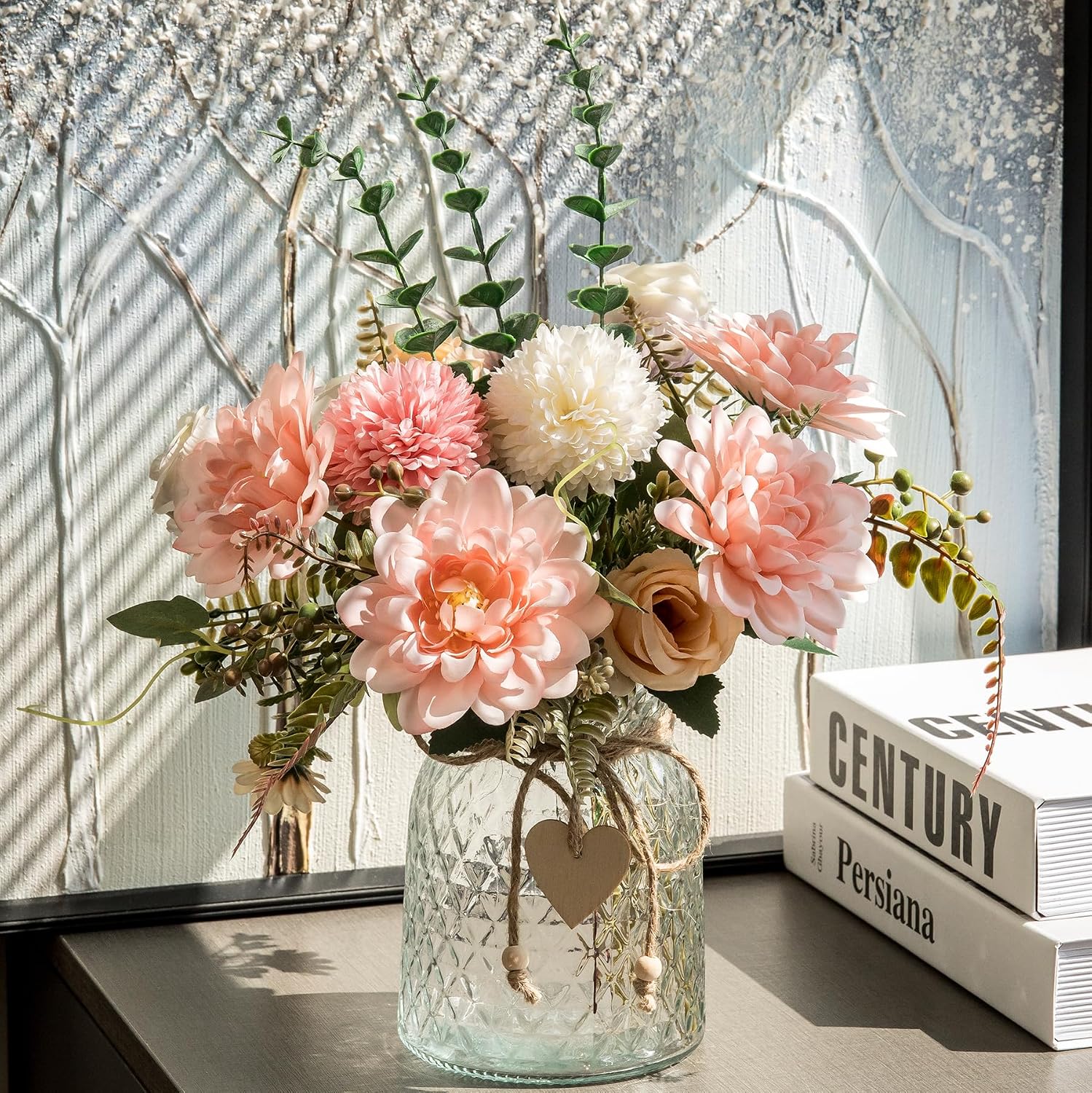
Faux flowers — meaning artificial blooms made from silk, polyester, latex, or preserved botanicals rather than cut stems — sound simple enough. But if you’ve ever watched a cheap arrangement go dusty and bleached within a few months on an office windowsill, or given someone a vase arrangement that arrived looking like a closed fist, you already know the gap between a faux floral that earns a daily “oh, I love those” and one that just sits there being decorative furniture. This article is specifically for spaces where real flowers can’t survive: cubicle desks, hospital rooms, interior offices with no natural light, and nightstands in windowless rooms. We’ll cover which product types and material categories actually hold up in those conditions, how to read product listings to spot realism before you buy, and how to match arrangement size to footprint. If you’re sourcing for yourself, gifting post-surgery, or outfitting a client’s no-window workspace, the decision framework at the end will give you a clear if-this-then-that path.
| EDITOR'S PICKForever Preserved Rose - Eterna… | Mid-tierYJ Fake Flowers with Vase | Budget pickFake Flowers with Vase | |
|---|---|---|---|
| Flower type | Rose | Roses | Dahlia |
| Container | Glass dome | Vase | Vase |
| Color | Red | White | Pink |
| Height | 9 in | — | — |
| Flower style | Preserved | Silk | Silk |
| Price | $39.99 | $26.99 | $21.99 |
| See on Amazon → | See on Amazon → | See on Amazon → |
Why No-Light, No-Care Spaces Demand a Different Product Logic
Real flowers need light, water, and airflow. Preserved florals — fresh flowers treated with glycerin and dyes to hold their structure — need low humidity and no direct sun to avoid color bleed. Neither is suited for a hospital tray table or a basement office. That makes fully synthetic arrangements (silk, polyester, PU latex, or high-density PE plastic) the practical default here — but the quality range inside that category is enormous.
The relevant realism markers for this use case are different from what you’d evaluate for a wedding arch or a living-room vase. At close range — desk distance, bedside distance — viewers see everything: petal texture, stem wrap, leaf veining, the way petals curl at the edge. At arm’s length on a shelf, a viewer reads silhouette and color. Most of the products that perform well in desk and bedside reviews succeed because they’ve optimized for the close-range test, not the across-the-room test.
What “close-range realism” looks for in listings:
- PU (polyurethane) or real-touch latex petals: These coatings give petals a slightly waxy, flexible feel that reads as organic rather than plasticky. Reviewers for the Mandy’s PU tulip arrangement consistently describe a texture surprise — they expected stiff polyester and got something that bends and springs back. That tactile realism translates to visual realism at desk distance.
- Acrylic faux water: A sealed vase with simulated water — a clear resin or acrylic pour that hardens inside the glass — is one of the strongest realism signals in the compact vase category. Reviewers for the Hollyone hydrangea in glass vase specifically call out the acrylic water illusion as convincing, noting it reads as real water under office lighting. This matters because a dry-bottomed glass vase with stems just jammed in looks like exactly what it is.
- Pre-set, vase-included arrangements: For desk and hospital use, the pre-arranged vase format beats loose stems in a separate vessel almost every time. Reviewers who gift loose stems to office recipients report that the recipient doesn’t have a vase, doesn’t have floral foam, and ends up with stems in a coffee mug. Pre-set arrangements ship as a complete object.
- Fixed vs. rearrangeable stems: Most acrylic-water vase arrangements have stems set into the resin — they are not rearrangeable. This is a trade-off: you lose styling flexibility, but you gain a stable, zero-maintenance object that won’t shift or tip. For a hospital room or a gift, that stability is a feature. For a designer who wants to adjust the arrangement, it’s a limitation.
The Size Math: What Actually Fits on a Desk
The standard office desk runs 24–30 inches deep. The ergonomic sweet spot for a decorative object — far enough to not crowd your work zone, close enough to read as intentional — is roughly 6–10 inches from the back edge. That puts the arrangement in your sightline without eating into usable surface.
Compact vase footprint guide:
| Arrangement type | Typical base diameter | Typical height | Fits standard desk? |
|---|---|---|---|
| Single-stem in bud vase | 2–3 in | 8–12 in | Yes, easily |
| Pre-set 3–5 stem vase | 3–5 in | 10–16 in | Yes |
| Hydrangea cluster in glass | 4–6 in | 12–18 in | Yes, back corner |
| Full dahlia arrangement | 5–7 in | 14–20 in | Tight; better on credenza |
The Artflower faux dahlia vase arrangement sits at the upper end of that range — reviewers who placed it on desks report it works best on a larger surface or a credenza rather than a standard 24-inch-deep workstation. The Hollyone hydrangea in glass vase, by contrast, earns consistent praise specifically for its compact footprint on nightstands and small surfaces.
Good Housekeeping’s roundup of artificial flowers notes that compact pre-arranged vases with a base under 5 inches are the most practical for desk use, and that taller, fuller arrangements benefit from shelf or credenza placement where height doesn’t compete with sight lines.
Gifting Logic: Hospital Rooms, Post-Surgery, and Promotion Gifts
There’s a distinct gifting use case running through reviews in this category that’s worth naming explicitly because it changes which product attributes matter.
Hospital rooms often restrict or discourage real flowers — allergy policies, immunocompromised patients, nursing staff preferences, and the simple logistical problem of wilting flowers that nobody waters. The Forever Preserved Rose glass dome has a clear pattern in its review trail: multiple buyers report giving it “instead of sending flowers” after a surgery or serious illness, with the dome format specifically chosen because it’s self-contained, requires zero care, and reads as a keepsake rather than a temporary arrangement. The glass dome signals permanence — it’s not a get-well arrangement that expires. It’s a small object the recipient keeps.
For professional promotion gifts, the Artflower faux dahlia vase arrangement has a documented use case: a buyer gifted it to a friend with a windowless office after a promotion, and multiple reviewers note the recipient assumed the flowers were real on first sight. That “fooled on first look” benchmark is the relevant performance metric for a gift going to someone who doesn’t expect artificial florals.
Gifting decision frame:
- Hospital / post-surgery: Prioritize sealed, self-contained formats. The glass dome or acrylic-water vase eliminates the “who’s going to water this” problem and reads as a keepsake.
- Office promotion / desk gift: Prioritize close-range realism — PU or real-touch petals, acrylic water, a compact footprint. The goal is “fooled on first look” by someone at desk distance.
- Bathroom or no-window bedroom: The YJ silk roses in vase earns specific praise for bathroom placement; the slightly diffuse light in bathrooms reads as softer, which forgives minor texture imperfections. Reviewers note it holds color well in low-humidity bathroom conditions.
The Spruce’s guide to artificial flowers notes that pre-arranged, vase-included faux florals are the highest-performing gift format for recipients who don’t have floral styling experience, because they require zero assembly or arrangement skill.
Long-Term Stability: What “Lasts” Actually Means Here
The Mandy’s PU tulip buyer who reports the flowers “make my day every time I see them” after a year and a half is giving you a data point that most product listings won’t surface: this category, done right, genuinely holds up at 18 months of daily desk exposure.
By the numbers:
- PU/latex petals in indoor, no-direct-sun conditions: reviewers report 2–4 years before visible texture degradation
- Polyester silk stems in similar conditions: 1–3 years before color fade becomes noticeable, faster near windows
- Preserved roses in sealed domes: manufacturer ratings typically cite 1–3 years; House Beautiful notes that preserved florals stored away from humidity and UV hold color significantly longer than that in practice
- Acrylic-water resin: indefinite stability; reviewers report no yellowing or cracking in 2+ year reviews
The enemy in this category is UV light, not time. Reviewers who placed faux arrangements near south-facing windows report faster color shift than those in interior offices or rooms with diffuse north-facing light. For genuinely windowless spaces, fading is almost a non-issue over a 2–3 year horizon with quality materials.
Apartment Therapy’s overview of faux botanicals notes that the most common failure mode for budget silk arrangements isn’t structural — it’s colorfast failure, where petals shift toward a washed-out, uniform tone that makes the arrangement read as clearly artificial.
Frequently Asked Questions
How long do faux flowers in a vase actually last without fading or falling apart?
In a windowless or low-light space — the primary environment this article covers — quality PU or silk arrangements routinely last 2–4 years before owners notice any meaningful degradation. The accelerant is UV exposure, not time. No direct sunlight means color and texture hold significantly longer than the standard “1–2 years” estimate most product pages use. Reviewers in interior-office contexts consistently report arrangements looking essentially unchanged at 18–24 months.
Does the acrylic faux water look convincing, or can you tell it’s fake?
At desk distance, a well-executed acrylic pour in a clear glass vase reads as real water to most viewers — particularly under warm or incandescent office lighting. The Hollyone hydrangea arrangement gets called out specifically for this in reviews. The tell, when there is one, tends to be at the stem-insertion points: if stems are perfectly parallel and evenly spaced rather than naturally fanned, the arrangement reads as set. The water itself is generally convincing.
Are these arrangements box-ready as gifts or do they need fluffing first?
Pre-set vase arrangements with acrylic water ship essentially ready — the stems are fixed and the arrangement holds its shape in transit. What may need attention: petals that compressed against box walls. Most reviewers report that a light finger-bend to reopen compressed petals takes 30–60 seconds. Loose-stem bundles in separate vases require more setup. If gift-readiness matters, choose a pre-set, vase-included format.
What size arrangement fits on a standard office desk without taking over the space?
A base diameter under 5 inches and a height under 16 inches fits comfortably on a standard 24-inch-deep desk without crowding the work zone. Arrangements in the 12–16 inch height range placed at the back corner of a desk occupy roughly the same footprint as a small plant pot. Anything over 18 inches tall is better suited to a credenza, shelf, or windowsill — it reads as too prominent at desk-level sightlines.
Can faux flowers in a sealed vase arrangement be rearranged or are they fixed?
In most acrylic-water vase formats, stems are set into the hardened resin and cannot be repositioned without damaging the arrangement. This is the correct trade-off for desk and gift use — zero maintenance, zero tipping — but it means you’re buying the arrangement as designed, not a styling tool. If rearrangeability matters (for a designer who wants to adjust proportions or swap stems), choose a loose-stem bundle in a separate vessel rather than a pre-set acrylic-water vase.
The Decision Rule
If the space has no direct sunlight and the priority is long-term stability with zero maintenance — desk, hospital room, windowless office — go with a pre-set vase arrangement featuring acrylic faux water and PU or real-touch petals. The fixed format and sealed base are features, not limitations.
If the arrangement is a gift for someone post-surgery or in a care setting, weight toward a sealed, keepsake-format piece — a glass dome or sealed vase — over a loose arrangement. It signals permanence and requires nothing from the recipient.
If the footprint is the constraint, the compact vase format (base under 5 inches) wins. Taller, fuller arrangements belong on shelves and credenzas, not desktop corners.
And if the budget is tight but close-range realism matters, PU petals over standard polyester is the single upgrade worth paying for. That’s the texture difference between “clearly artificial” and “wait, are those real?”