September 4, 2026 • Celeste Morrow • 11 min reading time • Prices verified June 6, 2026
Faux Geraniums for Outdoor Planters: A Brand-by-Brand Realism and Durability Comparison
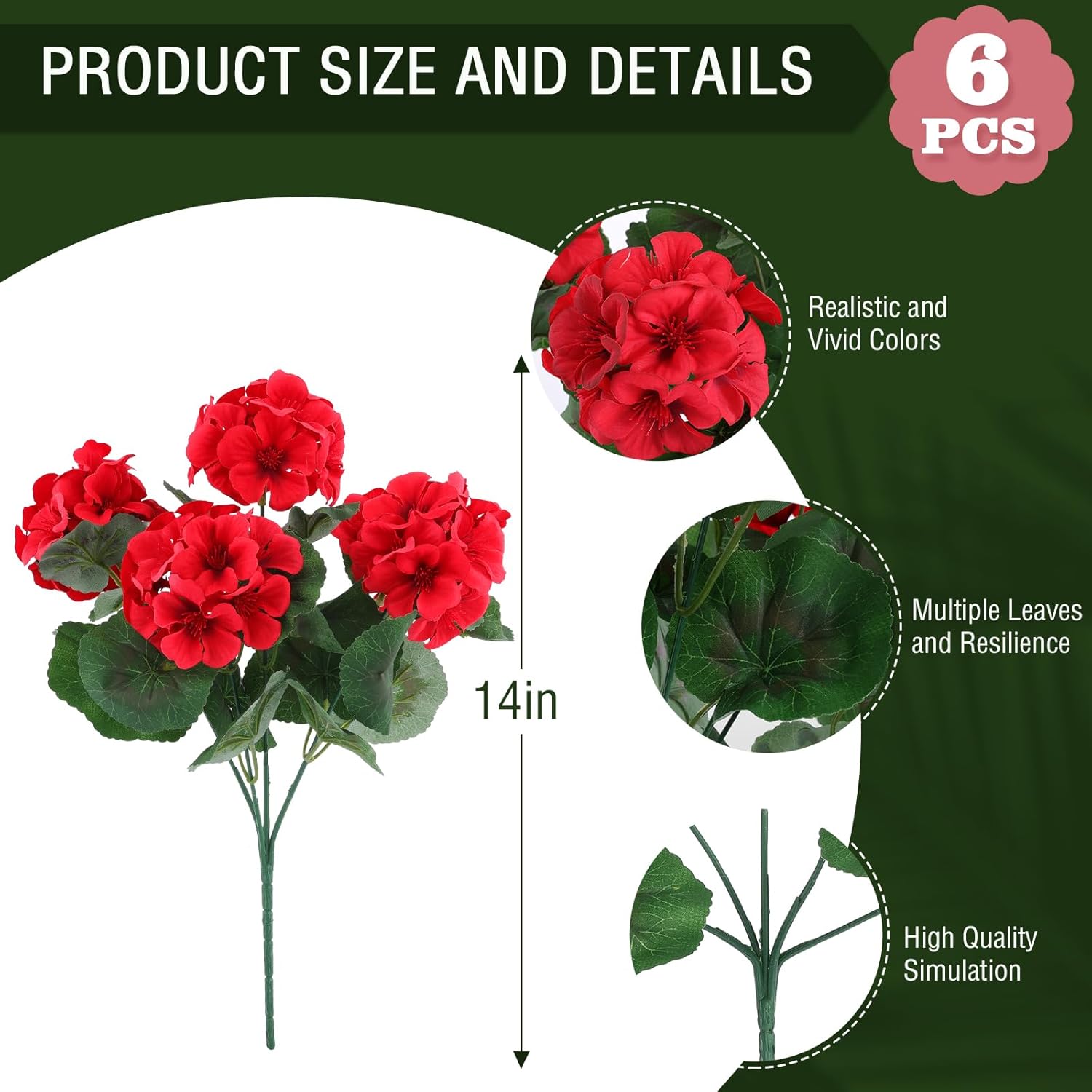
Faux geraniums — artificial flower stems designed to mimic the clustered blooms and textured round leaves of a real Pelargonium plant — have quietly become one of the best-selling outdoor faux botanicals on the market. The reason is straightforward: real geraniums demand consistent watering, struggle in extreme heat, and can die during the two weeks you’re on vacation. The faux version gives you the same burst of red, coral, or pink at the front door year-round without any of that. This article compares four widely reviewed faux geranium product tiers available as of mid-2026, looking specifically at UV resistance, realism at close range, stem length compatibility for different planter depths, and what owners across hundreds of purchases actually report going wrong. If you’re mid-decision — pot in hand, wondering which option won’t look chalky by August — this is the breakdown you need.
Why Outdoor Faux Geraniums Are a Different Category Than Indoor Silk Stems
This distinction matters before you spend anything. Most artificial flowers — including higher-end silk arrangements from premium indoor brands — are engineered for indoor use. UV exposure is not part of their performance specification. Place an indoor silk stem in a south-facing window box and you will typically see color shift within a single season: reds go orange, pinks go beige, greens go yellow-white.
Faux geraniums marketed specifically for outdoor planters carry a different construction baseline. The best ones use polyethylene (PE) — a dense, injection-molded plastic — for leaves and petals, which holds pigment significantly better than woven polysilk fabric. Some brands add what they describe as a double UV coating, a topical treatment applied to the material to slow photodegradation. The difference between a single-coated and a double-coated stem in a Phoenix or Florida summer is measurable in months, not days.
Good Housekeeping, in their editorial feature “Best Outdoor Artificial Plants,” identifies UV protection as the single most important specification to verify before buying any faux botanical for an exposed exterior position — and notes it is the specification most frequently omitted from budget product listings. That guidance holds: if a listing does not explicitly state UV treatment, assume it has none.
The Four Product Tiers: Construction, Performance, and Trade-Offs
Lovemoon Faux Geranium Set — Premium Tier
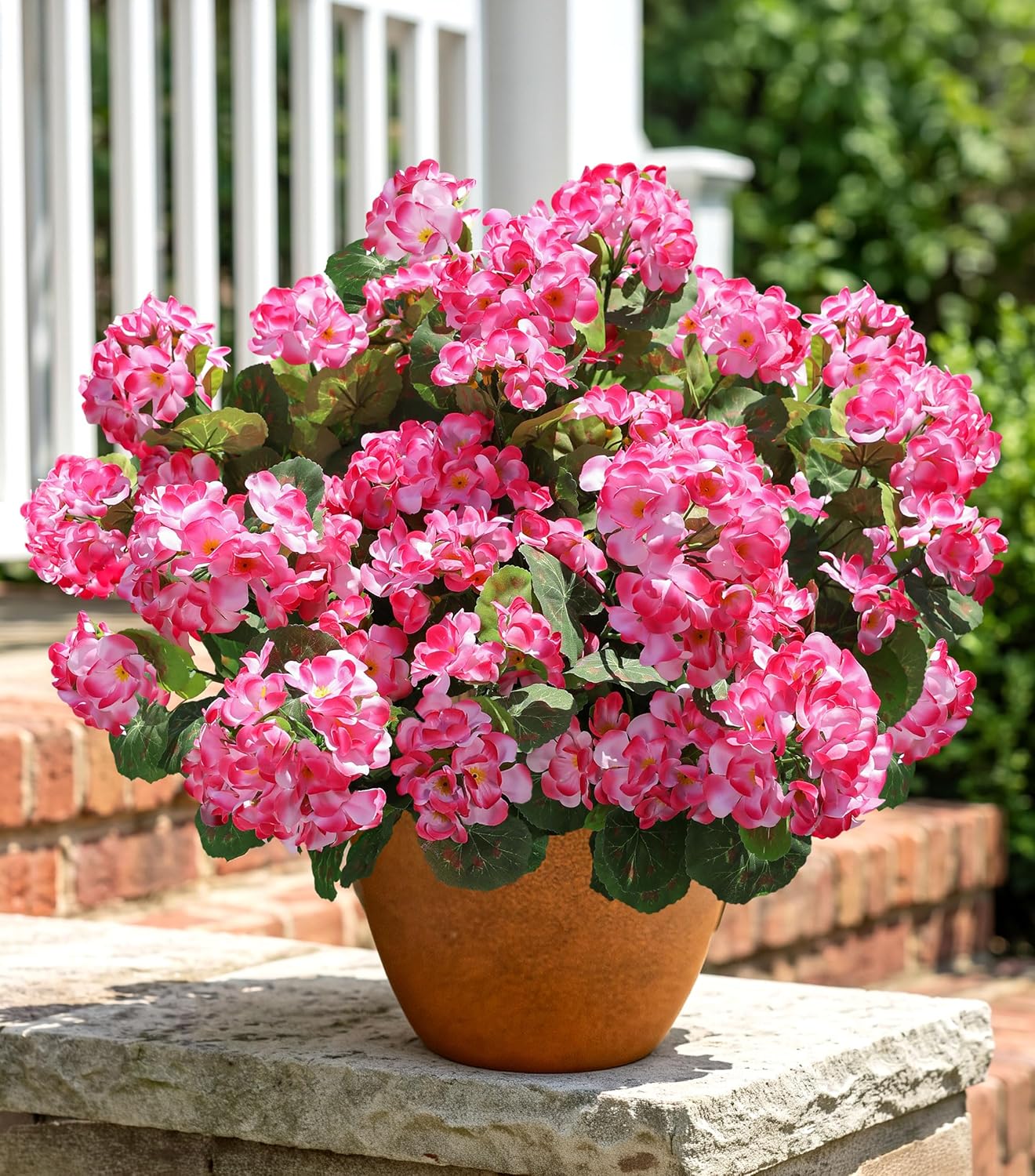
The Lovemoon set consistently draws the strongest realism feedback of the four tiers reviewed here. The detail that recurs across owner reports is leaf texture: reviewers describe visible veining and a slightly matte, papery surface finish that reads as botanical rather than plastic at conversational distance. A standout benchmark documented across multiple owner reviews is that a professional landscaper working on-site failed to identify the stems as artificial. That is a meaningful real-world realism test, particularly relevant for hotel entrances, staged properties, or any installation where viewers approach within arm’s reach.
The blooms use a layered petal construction that creates depth rather than the flat, uniform look common in lower-tier faux geraniums. Color vibrancy earns consistent praise, with reviewers noting that the reds read as saturated rather than brick-dull. House Beautiful, in their feature “Fake Plants That Actually Look Real,” reinforces that leaf detail is where the eye makes the artificial-versus-real judgment most quickly — which is why the Lovemoon set’s leaf-quality reviews carry outsized weight in this comparison.
The primary trade-off: stems arrive compressed from shipping. This is a near-universal complaint across every tier in this comparison, but Lovemoon reviewers mention it prominently. The recommended approach from multiple owners is a gentle pass with a hairdryer on low heat, or leaving stems loosely spread for 24 to 48 hours to relax back to shape.
Best for: Focal planters, luxury installations, staged properties, any placement where viewers approach within arm’s reach.
Artificial
$24.99
In stock on Amazon
Check price on AmazonAlupssuc 8-Piece Faux Geranium Set — UV-Priority Mid-Tier
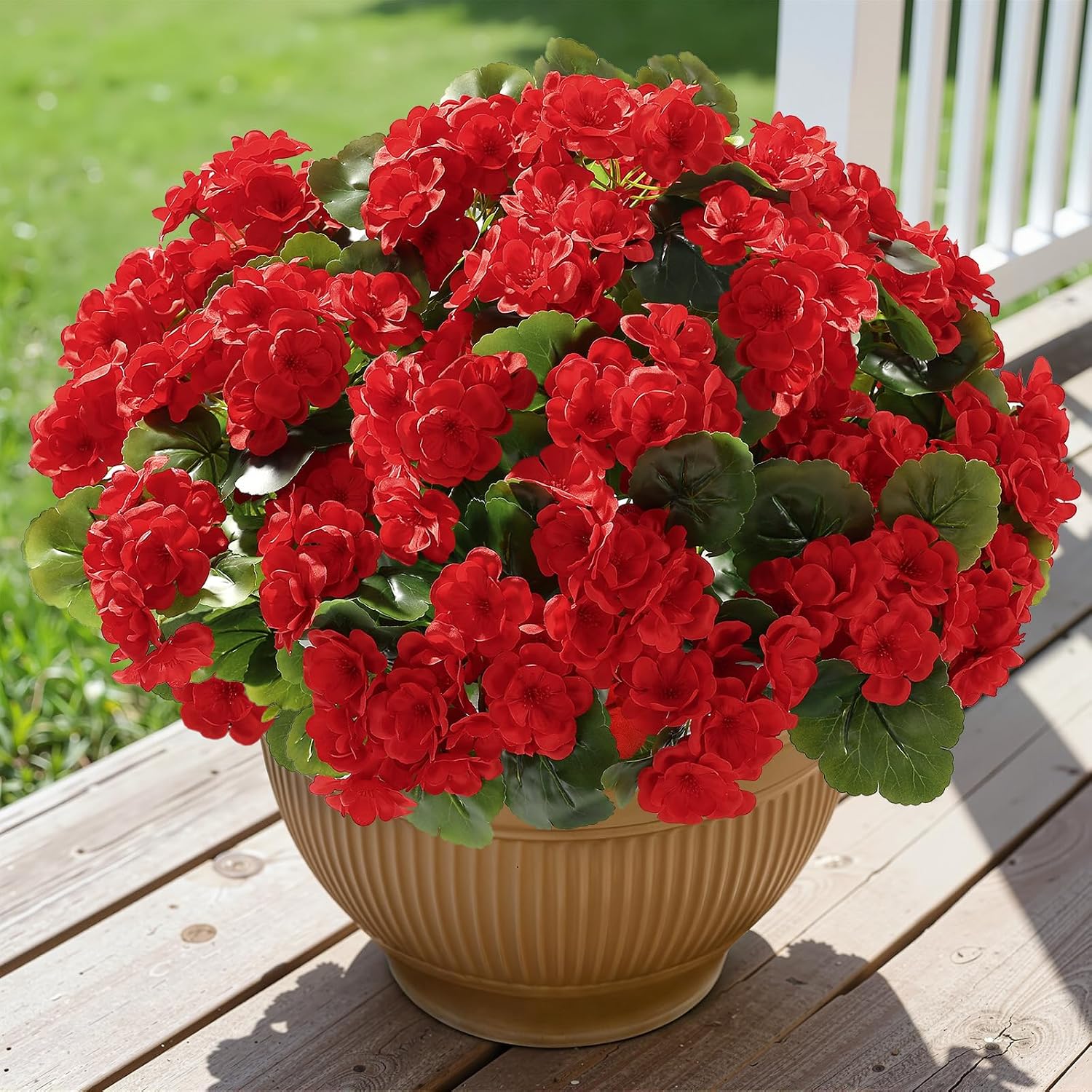
The Alupssuc 8-piece set attracts a specific buyer: someone dealing with a brutal southern exposure who searched specifically for UV-rated stems. The double UV-resistant claim is the documented purchase driver for this product tier — at least one owner explicitly states they chose it over alternatives for that language alone. That is useful signal for practitioners: if you are specifying for a rooftop installation, a sun-drenched courtyard, or a client property in the Sun Belt, this is the tier the UV-focused buyer gravitates toward.
The 8-piece count also changes the economics for volume orders. At a per-stem level, it is favorable for large planters or window boxes requiring dense fill. Color range tends toward the warmer end of the geranium palette — coral and red tones rather than cooler pinks.
Compressed shipping is again a consistent note. Reviewers using this product across multiple outdoor seasons report that color retention holds reasonably well through summer, though some fading is noted after 18 or more months in unshaded positions — which is about what you would expect even from double-coated PE under sustained UV load.
Best for: Sun-belt climates, rooftop exposures, large planters where volume fill and UV durability both matter.
Hananona
$23.99
In stock on Amazon
Check price on AmazonStandard Stem Sets — Shorter-Stem Variants — Verified-Fit Mid-Tier
This tier carries a concrete planning warning that belongs front and center: at least one documented reviewer reports that stems in this product category ran shorter than expected for their specific planter depth. This is not a vague complaint — it is a dimensional mismatch that affects installation outcomes. If you are working with deep window boxes (anything over 14 inches of interior depth) or large statement planters where visible stem length above the soil line matters, verify the listed stem measurement against your pot dimensions before ordering. If a listing does not state stem length explicitly, check the seller Q&A section before purchasing.
Outside that caveat, reviewers report solid color and acceptable realism at a step back — appropriate for a front stoop or garden border where viewers stay three or more feet away. Up close, leaf detail is less nuanced than the Lovemoon set, but bloom clusters read as convincing at viewing distance. This tier positions well for clients who need coverage at a lower per-stem investment, or for event work where planters serve as background elements rather than focal points.
Best for: Background planter positions, mid-budget client projects, shallow-to-medium planters where stem depth has been pre-verified.
Hananona
$23.99
In stock on Amazon
Check price on AmazonMulti-Stem Value Bundles — Volume Fill Budget Tier
The broader category of multi-stem value bundles — sets running 6 to 12 stems at a lower per-piece price — functions best as a fill strategy rather than a showcase purchase. Reviewers report acceptable performance when stems are used to fill secondary planters, edge arrangements, or positions where density matters more than realism at close range.
The compressed-stem problem is most pronounced in this tier, and UV coatings are typically single-layer. For a practitioner working within a tight budget on a large event installation, these sets make sense as volume fill, with a premium product anchoring the focal planters. Color retention at 12 months in full sun is acceptable; past 18 months in an unshaded southern exposure, expect visible color shift.
Apartment Therapy, in their guide “The Best Artificial Plants That Look Real,” identifies a consistent gap between product photography and what actually arrives: photos are shot under controlled light with freshly fluffed stems. For value-bundle tiers especially, written reviewer language — not product images — is the more reliable realism indicator. Look for descriptors like “textured,” “matte,” or “papery” for PE construction; treat “shiny” or “plastic-looking” in negative reviews as a meaningful red flag.
Best for: Event installations, background fill, secondary planters, any situation where per-stem cost is the primary constraint.
Alupssuc
$18.98
In stock on Amazon
Check price on AmazonComparison at a Glance
| Product Tier | Realism at Close Range | UV Claim | Stem-Length Warning | Best Use Case | Tier |
|---|---|---|---|---|---|
| Lovemoon Set | Highest (landscaper test) | Standard outdoor | None documented | Focal planters, luxury installs | Artificial — $24.99 |
| Alupssuc 8-Piece | Mid-tier | Double UV-resistant | None documented | Sun-belt / rooftop exposure | Hananona — $23.99 |
| Standard Stem Sets | Mid-tier | Standard outdoor | Yes — verify depth before ordering | Background fill, budget events | Hananona — $23.99 |
| Multi-Stem Value Bundles | Lower tier | Single-layer | General | Volume fill, event installs | Alupssuc — $18.98 |
Realism Variables That Product Photos Will Not Show You
Product photography for faux botanicals is typically shot under controlled light with freshly fluffed stems — and that is not what arrives in the box. Written reviews and product specifications are more reliable guides than images. Here is what to look for:
Leaf veining and surface texture. Smooth, uniform-gloss leaves are the fastest tell that a faux botanical is artificial. Reviewer language like “textured,” “matte,” or “looks papery” correlates with PE or real-touch construction. “Shiny” or “plastic-looking” in negative reviews is a red flag worth weighting heavily.
Petal layering. Flat single-layer petals read as artificial at any distance. Look for reviews that mention “depth” or “looks like real petals” as a proxy for multi-layer construction quality. The Lovemoon set earns specific praise on this point across multiple owner accounts.
Stem and calyx detail. The connection point between bloom and stem is where lower-cost construction shows first. Reviewers who comment that the attachment looks seamless are providing useful information no product photo will convey.
House Beautiful, in “Fake Plants That Actually Look Real,” consistently reinforces that leaf detail is where the eye makes the artificial-versus-real determination most quickly. That editorial finding aligns directly with what owner reviews document across the tiers in this comparison.
Frequently Asked Questions
How long do faux geraniums last in direct outdoor sun before fading? Based on aggregated owner reports across these product tiers, single-UV-coated faux geraniums in full southern exposure typically show visible fading between 12 and 18 months. Double-coated products extend that window, with multi-season owners reporting more stable color, though some shift is still noted past 18 months. Bringing stems indoors or into shade during the harshest summer months meaningfully extends lifespan regardless of coating level.
Do leaves look as realistic as the blooms up close? Depends on the tier. For the Lovemoon set, multiple reviewers specifically praise leaf quality as the realism anchor — the blooms read as attractive, but the leaves are what passed the landscaper test. For other tiers in this comparison, blooms tend to hold up better than leaves at close inspection.
What is the best way to anchor faux geranium stems in a planter so they do not blow over? The most effective method reported by outdoor planter owners is floral foam cut to fit the planter interior, topped with decorative rock, gravel, or faux soil to conceal it. Some reviewers use weighted sand at the base of the planter for additional ballast. Wire-wrapping individual stems together before inserting them into foam creates a more stable cluster. The Spruce, in their guide “How to Care for Geraniums,” notes that even real geraniums in containers require firm root anchoring — the principle translates directly to faux versions in any position exposed to wind.
Are stems long enough for deep window boxes and large pots? This is the most critical pre-purchase check. Measure your planter’s interior depth and compare it against the product’s listed stem length. Add roughly 4 to 6 inches of visible stem above the soil line for a natural look. If a listing does not provide stem length, check the Q&A section before ordering. The reviewer warning documented in the standard stem-set tier is the clearest evidence that this step matters and that skipping it leads to installation problems.
Can faux geraniums survive a hailstorm or heavy wind event? PE-constructed faux botanicals are more durable than woven silk stems in weather events — they do not absorb water and are less prone to petal shredding. Owners report that PE blooms recover from moderate wind. Heavy hail at high velocity can dent or chip petal edges on any plastic-based product. The practical answer: faux geraniums will survive most weather better than real plants, but a severe hailstorm can cause cosmetic damage. Moving statement planters under cover during severe weather warnings remains the safest approach.
Is the hairdryer fluffing method safe for all materials used in these products? For PE-constructed stems, low heat on a standard hairdryer is safe and effective. The heat relaxes the shape memory from compressed shipping without damaging the material. For woven polysilk or fabric-petal products, use cool air only, or simply let stems sit loosely arranged for 24 to 48 hours. High heat can cause fabric petals to curl or lose their set. If a product listing does not specify PE versus polysilk construction, default to the no-heat method.
The Decision Rule
If your installation is in direct, unshaded sun in a hot climate — and you need stems to hold color through a full season without intervention — the double UV-rated 8-piece tier is the differentiator worth paying for. If realism at close range is the priority — a hotel entrance, a staged home, anywhere a person walks up and looks — the Lovemoon set is where the review evidence points most clearly. If you are specifying for background planters at an event or need high stem count at a lower per-piece cost, multi-stem value bundles fill that role, with the understanding that you are trading UV longevity and close-up realism for coverage and economy. And regardless of which product you choose: measure your planter depth against the listed stem length before you order, or you may end up with a set that disappears below the rim.
Sources cited in plain text: The Spruce, “How to Care for Geraniums”; Good Housekeeping, “Best Outdoor Artificial Plants”; Apartment Therapy, “The Best Artificial Plants That Look Real”; House Beautiful, “Fake Plants That Actually Look Real.”