September 8, 2026 • Celeste Morrow • 11 min reading time • Prices verified June 6, 2026
Faux Sunflowers and Wildflower Mixes: The Underrated Stem for DIY Bouquets, Graves, and Kitchen Tables
Faux flowers — artificial or silk stems made to look like real botanicals — have a reputation problem. People assume they’re either the dusty plastic grocery-store variety or the kind of convincing, expensive set piece reserved for luxury hotel lobbies. Sunflowers and wildflower mixes sit in an interesting middle ground: they’re casual enough to feel approachable, but when you pick the right product, they’re also realistic enough to carry a wedding, dignified enough for a memorial, and durable enough to stay on a kitchen table through months of humidity and cooking steam. This guide is for buyers who’ve already made their first purchase or two and are now trying to make smarter calls — sizing a bouquet correctly, choosing a mix that doesn’t look like a craft kit explosion, knowing what holds up outdoors. We’ll cover all of it, with actual numbers and honest trade-offs.
| EDITOR'S PICKHUAESIN Sunflowers Artificial F… | Mid-tierCEWOR Artificial Sunflowers Fak… | Budget pick20pcs Eucalyptus Stems Artifici… | |
|---|---|---|---|
| Flower type | Sunflowers | Sunflowers | Eucalyptus |
| Stems included | — | — | 20 |
| Cemetery use | ✓ | ✓ | — |
| Bridal use | — | ✓ | — |
| Material | Silk | — | — |
| Arrangement type | Bouquet | Bouquet | Loose stems |
| Price | $27.99 | $22.99 | $7.58 |
| See on Amazon → | See on Amazon → | See on Amazon → |
Why Sunflowers and Wildflower Mixes Earn a Category of Their Own
Most faux stem categories have a dominant use case. Roses are for romance and formal tablescapes. Peonies are for wedding arches and living room focal points. Orchids are for minimalist shelf styling. Sunflowers and wildflower mixes, by contrast, show up in a genuinely unusual range of contexts: bridesmaids’ bouquets, cemetery placement, kitchen hutch arrangements, farmhouse dining tables, and children’s room decor. That versatility is the category’s core asset — and its main sourcing challenge.
The challenge is that “wildflower mix” is one of the loosest descriptors in the faux floral market. It can mean a curated bundle of ranunculus, cosmos, and Queen Anne’s lace stems that would look at home in a Scandinavian interior, or it can mean a riot of oversaturated synthetic blooms that reads as overtly artificial from across the room. The gap between those two outcomes is almost always a function of three things: petal material (how the surface is made and coated), color calibration (whether the palette is muted and botanically plausible or punchy and synthetic-looking), and stem construction (whether individual stems have realistic leaf placement and branch structure, or whether they’ve been glued in uniform rows).
Good Housekeeping’s roundup “Best Artificial Flowers” consistently flags petal texture and color variance as the primary realism differentiators in the under-$30 stem segment — both factors that product photos often obscure but that reviewers reliably surface after the box arrives.
By the numbers:
- A standard bridesmaid bouquet uses 8–12 stems, depending on stem diameter
- A cemetery or memorial arrangement in a ground stake vase typically needs 5–8 stems
- A kitchen table bud vase cluster (3 vases, staggered heights) works well with 12–15 mixed stems
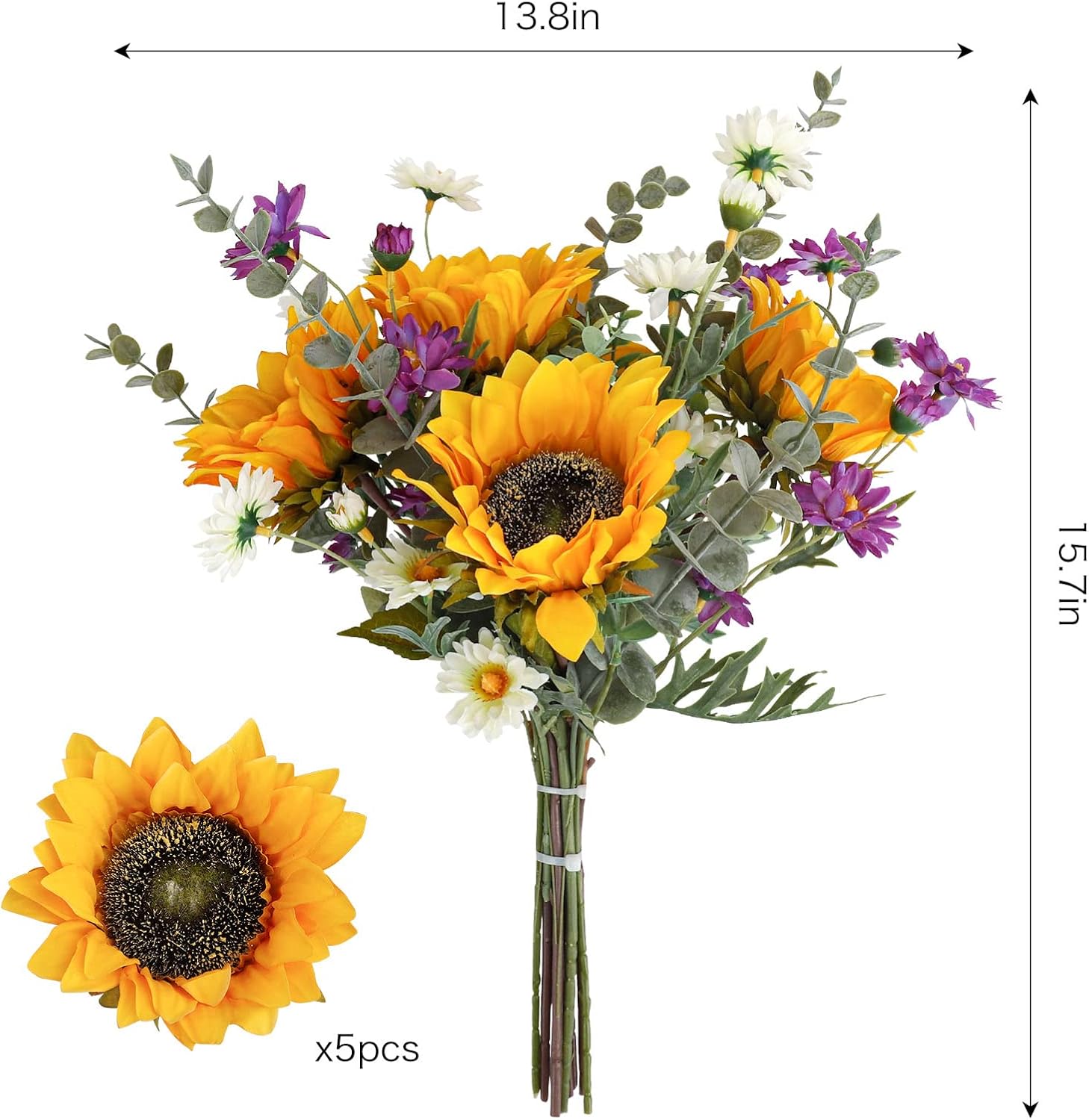
- Full-size faux sunflower heads should approximate a real sunflower’s 4–5 inch face diameter — look for this measurement in product specs before buying
The Memorial Use Case: What to Know Before You Buy for a Grave or an Urn
This section is written with care because the context demands it. A meaningful share of wildflower and sunflower buyers aren’t decorators. They’re people who have lost someone and are trying to keep color and life near that person’s memory without making weekly pilgrimages to replace wilting stems. That’s a legitimate, dignified use case, and the product requirements are specific.
Outdoor durability matters more than anything else here. Real sunlight is aggressive — UV exposure fades synthetic pigments, and repeated wetting and drying cycles degrade some petal coatings faster than others. When reading through verified buyer reviews for wildflower mixes positioned as outdoor-suitable, the accounts that carry the most weight are ones from buyers who placed stems on a grave or near a memorial urn and returned weeks later to find the arrangement still holding color and structure. Those use-case-specific observations tell you something that spec sheets cannot.
Particularly resonant are reviews in which buyers describe replacing the flowers near a late parent’s urn with a faux wildflower arrangement — noting that a soft, natural color palette and a varied mix of stem types made the display feel like a real tribute rather than a budget placeholder. That kind of reviewer language tells you the product reads as sincere and considered, which matters in this context as much as any durability metric.
What to look for when buying for memorial placement:
- UV-resistant coating — look for this in the product description or brand specs; it is not universal
- Wired stems — these allow you to anchor stems in floral foam or a stake vase without them shifting in wind
- Muted, naturalistic color palettes — oversaturated colors read as cheap faster than anything, especially outdoors in full sun
- Stem count per pack — memorial arrangements tend to be compact; a pack of 10–12 stems is usually sufficient and avoids waste
Apartment Therapy’s article “How to Make Faux Flowers Look Real” emphasizes that color authenticity — specifically, the presence of natural color variation within a single bloom rather than flat, uniform pigment — is the factor most responsible for whether an arrangement reads as real or artificial at a respectful viewing distance.
Sizing for Bouquets: The Math Behind Getting It Right
Bridesmaids’ bouquets are one of the most common volume use cases for faux sunflowers, and one of the most under-quantified. Here’s the decision frame:
A hand-tied round bouquet — the standard shape for a bridesmaid — typically measures 7–9 inches in diameter at the flower face. A full-size faux sunflower head runs about 4–5 inches across, meaning you’ll need approximately 5–7 sunflower stems as the primary bloom layer, plus 4–6 filler stems (smaller wildflowers, greenery, or accent blooms) to fill negative space and create visual texture.
When evaluating faux sunflower stems for bouquet use, pay close attention to reviewer language about structural stability at the stem-to-head junction. Some faux sunflowers have oversized, floppy heads that sag under their own weight once multiple stems are gathered together. Reviewers who describe stems as “true to size” and note that heads hold their shape after wrapping are flagging exactly the right quality signal for this use case. Structural stability at the stem-to-head junction is a critical spec for bouquet use that rarely appears in product listings but surfaces reliably in reviewer accounts.
Practical buying strategy for a bridesmaids’ bouquet set:
If you’re outfitting a wedding party of four bridesmaids, plan on:
- 28–32 sunflower stems (7–8 per bouquet)
- 20–24 filler/accent stems
- A total pack count that accounts for 10–15% waste from stems that arrive bent or with petal defects
Brides.com’s guidance on DIY bridesmaid bouquets — covered in their article “How to Make a Bridesmaid Bouquet” — recommends working in a consistent color palette with no more than three bloom types for a cohesive result. Sunflowers as the primary bloom, one smaller accent such as ranunculus or cosmos, and a greenery filler is a reliable three-element structure that reads as intentional rather than assembled by chance.
Wildflower Mixes and the “Craft Store” Problem
The most common fear among intermediate buyers moving from standard roses and peonies into wildflower territory is that the result will look like a craft store project — bright, stiff, recognizably synthetic. It’s a valid concern, and the answer isn’t always about price point.
The craft-store read usually comes from one of three sources:
- Flat, uniform petal color — real wildflowers have tonal variation within a single petal, from center to edge. Products that render petals in one flat color read as plastic regardless of material.
- Symmetric leaf placement — real stems have leaves at irregular intervals and angles. Faux stems with uniform, mirrored leaf placement announce themselves as artificial immediately.
- Unnatural stem rigidity — real wildflower stems have a slight flex and natural curve. Stems that are perfectly straight with no give read as artificial at a glance.
The Spruce’s “The Best Artificial Flowers” review coverage consistently identifies these three markers as the primary differentiators between convincing and unconvincing faux botanicals — and they apply especially strongly to wildflower mixes, where the category’s whole appeal is its organic, gathered-from-a-meadow quality.
Martha Stewart Weddings’ coverage of wildflower wedding ideas notes that the most effective wildflower-style arrangements use volume and imperfection as design tools — stems at varying heights, a few blooms that appear to be at different stages of opening, and color that leans toward the desaturated end of the palette. These are choices a buyer can make at the assembly stage even with mid-tier stems.
The ranunculus sizing note: Ranunculus — a flower with layered, rose-like petals common in wildflower mixes — is particularly useful for small-vase arrangements. When comparing faux ranunculus options, look for stems in the range of 7–8 inches tall with bloom faces around 4–5 inches wide; this profile fits cleanly into a standard bud vase or a low compote arrangement without overwhelming the vessel. If you’re building a kitchen hutch display or a bathroom shelf cluster, that size range is directly actionable as a buying filter. Note: always verify exact dimensions in the product listing rather than relying on category averages, as individual products vary.
If X, Then Y: The Decision Rules
After pulling together reviewer patterns, published specs, and use-case data, here’s how to make the call:
If you’re buying for a bridesmaids’ bouquet set, prioritize structural stem stability over petal complexity — a head that holds its shape under the weight of being gathered and wrapped matters more than subtle veining detail. Buy at least 10% more stems than your bouquet math suggests.
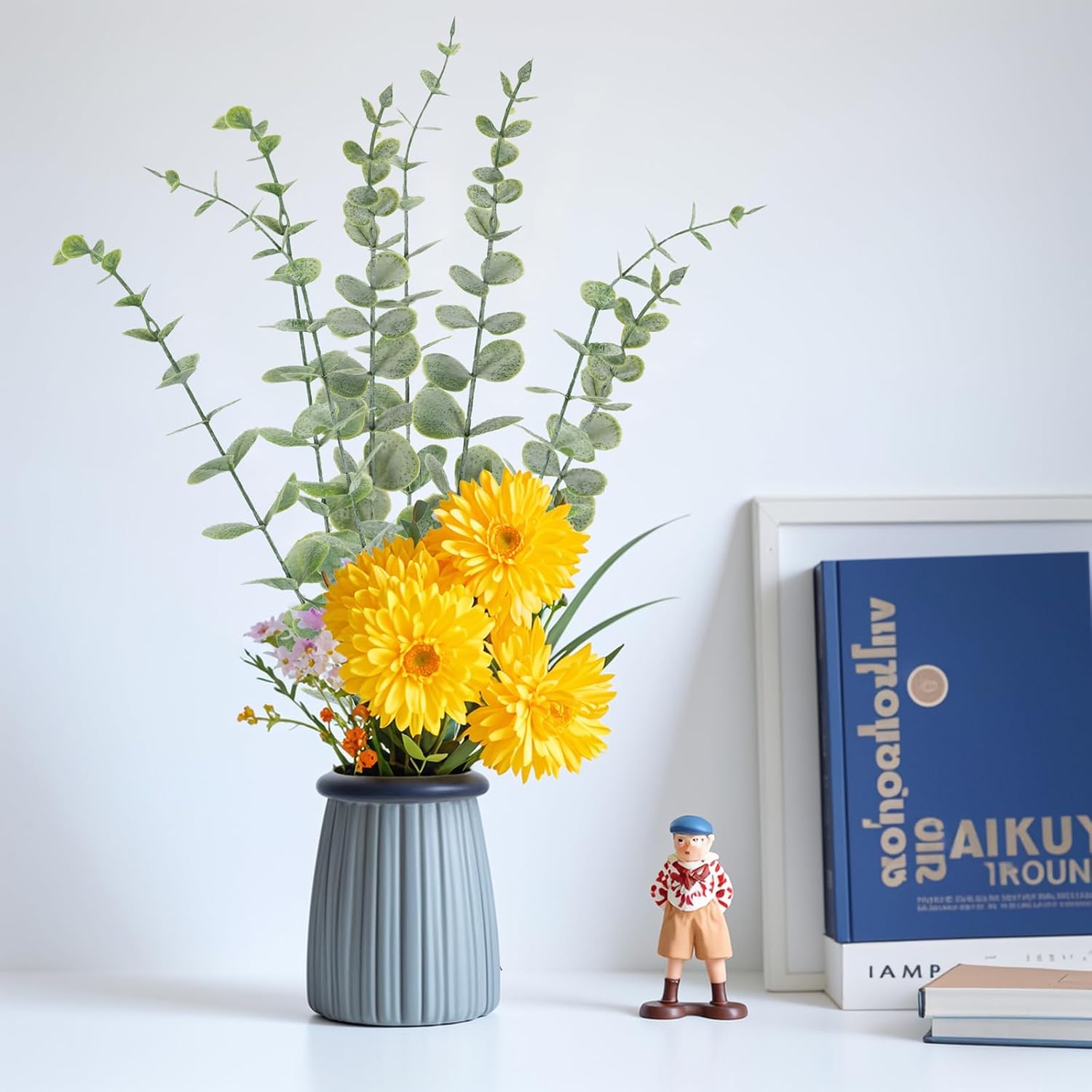
20pcs
$7.58
In stock on Amazon
Check price on AmazonIf you’re buying for a memorial or cemetery placement, prioritize UV-resistance and naturalistic color over stem count. A smaller, well-chosen arrangement in muted tones will outlast and out-dignify a larger, saturated one. Look for reviewer accounts that specifically describe outdoor placement at a grave or memorial site — that use-case data is more reliable than any spec sheet claim.
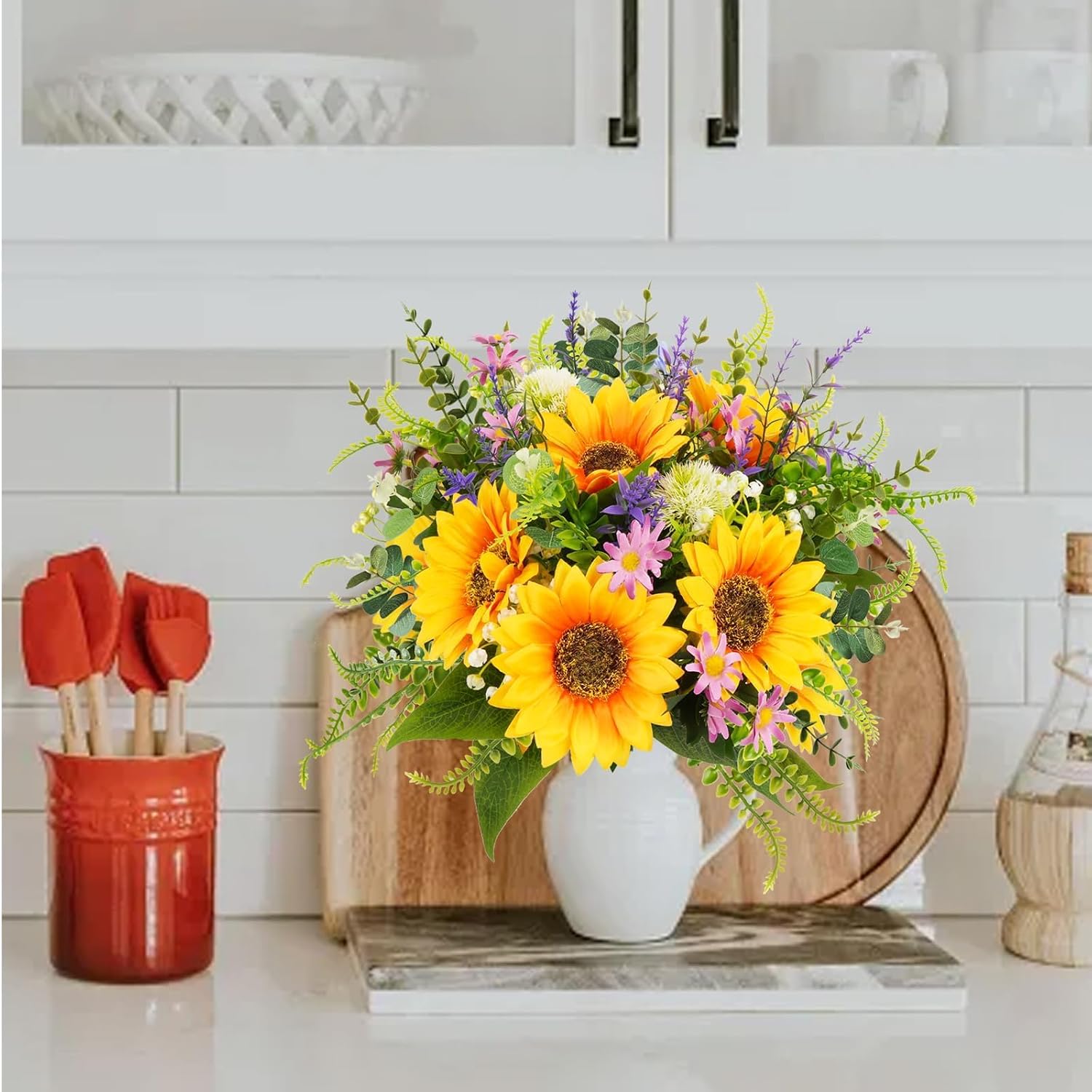
CEWOR
$22.99
In stock on Amazon
Check price on AmazonIf you’re buying for a kitchen table or everyday home vase, the “craft store” risk is real and the fix is restraint: choose mixes with desaturated palettes, limit your bloom types to three or fewer, and use odd numbers of stems. For small-vase builds, anchor your stem-height selection to what fits proportionally in your vessel — a stem that rises roughly 1.5 times the vase height is the standard floral design ratio.
CEWOR
$22.99
In stock on Amazon
Check price on AmazonIf you’re outfitting multiple arrangements for a wedding or event, buy in single SKU lots large enough to avoid dye-lot variation between packages — color calibration can shift meaningfully between production batches.
HUAESIN
$27.99
In stock on Amazon
Check price on AmazonFrequently Asked Questions
How many faux sunflower stems do I need for one bridesmaid bouquet? Plan for 7–8 sunflower stems as your primary bloom layer, plus 5–6 filler stems for a round, hand-tied bouquet in the standard 7–9 inch diameter range. If your sunflower heads are on the larger end (closer to 5 inches across), you can work with 5–6 primary stems without the bouquet reading as sparse.
Will a wildflower faux bouquet hold up outdoors at a cemetery through rain and sun? It depends on the product. Look for UV-resistance noted explicitly in the product specs, and choose wired stems that can be anchored securely in a stake vase or floral foam. Seek out reviewer accounts from buyers who specifically describe cemetery or outdoor memorial use — that context-matched feedback is the most reliable quality signal available. Avoid fully exposed south-facing placement in climates with intense summer sun; even UV-resistant products will fade faster under direct, sustained exposure.
Can I mix faux sunflowers with real greenery in the same arrangement? Yes, and it often improves the result. Real eucalyptus, ferns, or fresh-cut foliage add genuine texture and a natural scent that helps the overall arrangement read as less synthetic. The caveat: fresh greenery will wilt within a week, so this works best for event-day arrangements rather than permanent home displays. Brides.com’s article “How to Make a Bridesmaid Bouquet” and The Spruce’s artificial flower coverage both note that mixing real foliage with faux blooms is one of the most effective ways to elevate a faux arrangement’s perceived realism without upgrading to more expensive stems.
What size vase works best for compact ranunculus-style stems? For faux ranunculus stems in the 7–8 inch height range with bloom faces around 4–5 inches wide, a standard bud vase (4–6 inches tall, 2–3 inch opening) works well for single stems. A low cylinder or compote vase (4–5 inches tall, 4–5 inch opening) works for small clusters of three to five stems. Avoid tall, narrow vases — the stem length won’t provide enough depth for stable anchoring and the proportions will read as awkward.
Do faux wildflower mixes look too “craft store” for home decor, or can they look natural? They can absolutely look natural, but it requires intentional editing. The key markers to avoid: flat uniform petal color, perfectly symmetric leaf placement, and uniform stem height. Choose mixes with tonal color variation within individual blooms, arrange stems at staggered heights, and limit your palette to two or three hues. Apartment Therapy’s “How to Make Faux Flowers Look Real” consistently finds that restraint in color and variety — not premium price — is the primary driver of whether a wildflower mix reads as considered or craft-kit.