September 25, 2026 • Celeste Morrow • 11 min reading time • Prices verified June 6, 2026
The No-Experience Arranger's Guide to Faux Stems in Tall Vases
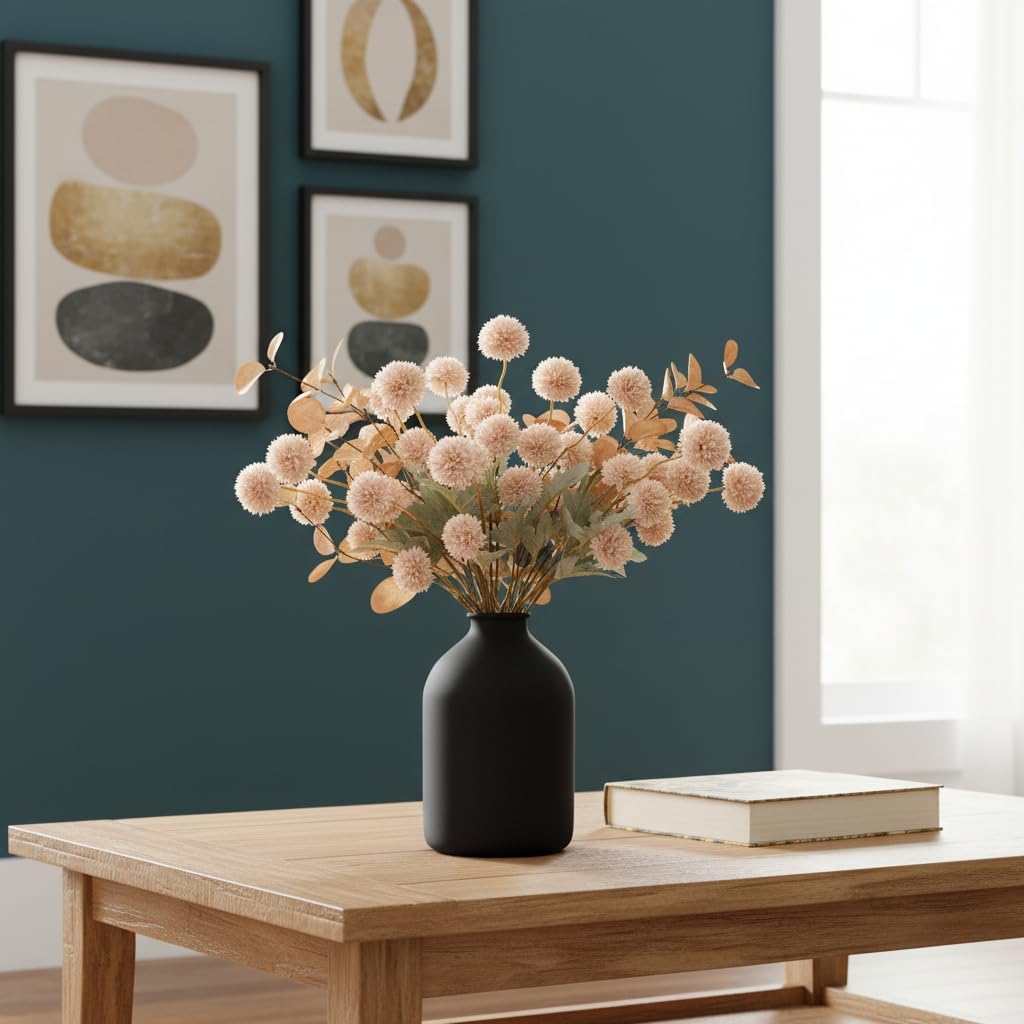
Faux stems — that’s the industry shorthand for artificial flower stems made from silk, polyester, or latex rather than real plant material — have quietly crossed a quality threshold that makes them genuinely hard to distinguish from fresh botanicals in a well-lit room. If you’ve never arranged flowers before, that matters for a specific reason: a high-quality faux stem arrives pre-shaped, pre-colored, and fully bendable, which means the product itself is doing most of the design work. You’re not compensating for wilting or fighting with conditioning water; you’re just placing things where they look good and bending the stems until the angles feel right. This guide is built around that insight. By the end, you’ll know exactly how many stems fill a tall vase without looking sparse, whether you need any special supplies, and which product combinations reviewers with zero experience are calling “professional” and “high-end” — without exaggeration and without a floral design course.
Why the Stems Are Doing the Work (And What That Actually Means)
The phrase “fully wired” appears constantly in faux stem product descriptions, and it’s the single most important specification for a beginner working with tall vases. Here’s what it means in practice: a fully wired stem has a continuous wire core running from the base all the way up through every branch, sub-branch, and leaf. You can bend any segment — the main stalk, an individual petal cluster, a single leaf — and it holds that angle without springing back. A partially wired stem, by contrast, may have a rigid lower stalk but floppy upper branches that collapse or droop when you need them to fan outward.
For tall vase work specifically, this distinction is decisive. When a stem sits 18–24 inches inside a vase with only the top third visible, the visible portion needs to hold a deliberate outward angle — otherwise every stem points straight up and the arrangement looks like a fistful of pencils. Fully wired stems let you pre-bend that outward lean before you even drop the stem into the vase.
The Floral Design Institute, in its published curriculum on stem proportion and vase geometry, notes that the standard “rule of 1.5” — where the visible stem height above the vase rim equals 1.5 times the vase height — gives arrangements their sense of scale and fullness. Fully wired faux stems let a beginner achieve this geometry without any mechanical aid because you can literally sculpt the curve before placement.
Reviewers of beige and neutral mum sets consistently describe this effect: they placed stems, bent the outer ones slightly outward, and the arrangement “looked finished.” No filler, no foam, no second trip to the store. That’s the wired stem doing the design work — not skill the buyer brought to the table.
Stem Counts, Vase Math, and the “Full Without Fillers” Threshold
The beginner’s primary anxiety about tall vases is sparseness. A standard tall cylindrical vase — say, 18 inches high with a 4–6 inch mouth — has a small opening relative to its height, which actually works in your favor: the vase itself acts as a natural grid that holds stems apart and prevents crowding. The visual “fullness” problem is almost entirely about the fan of stems above the rim, not the density inside the vase.
By the numbers — filling a standard tall vase:
| Vase mouth diameter | Minimum stems for “full” look | Comfortable range | Where reviewers land |
|---|---|---|---|
| 3–4 inches | 5–7 stems | 6–9 | 6 stems (pompon mum, wide-mouth vase) |
| 5–6 inches | 7–10 stems | 9–14 | 10–12 stems (beige mum sets) |
| 7–8 inches | 12–16 stems | 15–20 | 15–18 stems (mixed stem bundles) |
These ranges align with guidance in The Spruce’s editorial overview “How to Arrange Artificial Flowers,” which identifies stem-to-mouth-diameter ratio as the primary determinant of perceived fullness. The consistent reviewer finding for beige and neutral mum sets is that a single bundle includes enough stems to fill a large vase without supplementing — which directly addresses the “do I need to buy more?” anxiety that sends beginners down rabbit holes.
Mixed stem sets earn repeated mentions precisely because reviewers report being able to fill two vases from a single order. For anyone setting up a pair of flanking arrangements — an entryway, a dining table with bookend vases, a stage backdrop with symmetrical accent points — one order solving both sides is a meaningful efficiency.
Pompon mum reviewers note that six stems in a wide-mouth vase produced a complete-looking arrangement with no filler. That’s a useful data point: pompon mum heads are volumetrically generous, so each stem contributes more visual mass than a spindly branch would.
Prep Steps That Actually Matter (And Ones You Can Skip)
House Beautiful’s styling article “How to Make Fake Flowers Look Real” consistently flags one prep step that beginners skip: shaping before placement. Most faux stems arrive compressed from shipping — branches folded flat, petals slightly crushed against each other. Five minutes of pre-shaping (opening petals, bending branches to their natural angle, separating leaf clusters) makes a larger difference to the final look than any arrangement technique.
The delphinium is an interesting case study here. Reviewers note that delphinium stems tend to arrive with their natural upright form mostly intact — minimal shaping required, just gentle straightening along the main stalk. That’s a meaningful contrast from stems that arrive looking like they’ve been vacuum-packed; it also makes delphinium a strong choice for beginners who want fast setup.
Steps that matter:
- Pre-shape every stem before it goes in the vase. Open petals, fan branches outward, separate leaves.
- Test height dry — drop the stem in without committing, check proportions, trim only if you need to. The 1.5x rule (visible stem = 1.5× vase height) is your target.
- Place the tallest stems first (center), then work outward with progressively lower or more angled stems.
- Bend outer stems outward after placement to create the fan shape. This is where wired stems earn their price premium.
Steps you can skip:
- Floral foam. For tall vases with a narrow mouth, the vase geometry holds stems upright on its own. Foam is useful for wide, low bowls — not tall cylinders.
- Decorative filler pebbles or sand, unless your vase is transparent and the interior would otherwise look empty. Even then, a simple layer of river rock from any home goods store works fine.
- Measuring tools. Eyeball the 1.5x proportion — Apartment Therapy’s article “The Best Fake Plants That Actually Look Real” notes that accurate-enough stem height proportion reads as intentional to any observer who isn’t a professional stylist.
Mixing Stems From Different Orders: When It Works and When It Fights Itself
The practical question for anyone building arrangements gradually — buying one bundle now, adding another later — is whether stems from different product orders will look coherent together. The honest answer is: usually yes, with one important variable.
The variable is color temperature. Faux florals in the beige-to-cream-to-ivory range can skew either warm (toward gold and peach undertones) or cool (toward gray and taupe). Warm-toned beige mum sets paired with cool-toned white delphiniums will look slightly mismatched even if neither is “wrong” on its own. Apartment Therapy’s coverage of faux botanical realism in “The Best Fake Plants That Actually Look Real” specifically calls out undertone matching as the step most buyers miss when mixing product lines.
The safest mixing strategy for beginners: stay within a single color family from a single brand, or use explicit neutrals — true white, true green, or dark burgundy — as bridges between sets. Pompon mums in cream pair reliably with nearly any other neutral stem precisely because their color is saturated enough to anchor rather than clash.
Stem silhouette is the secondary consideration. A delphinium’s tall, narrow spike alongside a full pompon mum head creates intentional contrast — that’s a classic “thriller and filler” pairing that the Floral Design Institute’s published curriculum on stem proportion identifies as a standard structural approach. But two stems that are similarly sized with similar head shapes can compete rather than complement. When in doubt, vary the silhouette: one spiky vertical element, one round cluster element, one trailing or cascading element.
House Beautiful’s arrangement guidance reinforces this point directly: editors recommend pairing at least two distinct stem silhouettes in any tall vase arrangement, with one element providing vertical structure and the other providing horizontal mass. The mum-and-delphinium combination maps cleanly onto that framework.
Product Combinations That Reviewers Call “Professional” Without Effort
The arrangement pattern that emerges most reliably from buyer reviews of neutral and beige faux stem sets follows a simple logic: one stem type handles fullness, one handles height, and the color families overlap closely enough that no bridging element is needed.
The mum-and-delphinium baseline. Neutral mum or pompon mum sets serve as the primary volume element — wide-headed, densely petaled, generous in visual mass. Delphinium stems add vertical height contrast with their narrow spike form. Together, they produce the structural relationship that The Spruce’s “How to Arrange Artificial Flowers” describes as the foundation of most traditional floral arrangements: a tall focal element surrounded by lower, rounder supporting elements. Both stem types arrive fully wired and require minimal pre-shaping, which is exactly why reviewers with no design background describe the results as looking finished.
Adding a third element. Reviewers who describe “high-end” results without added effort almost always mention a third stem with a trailing or draping quality — a eucalyptus branch, a willow stem, or a loose leafy element that softens the transition between the tight mum cluster and the upright delphiniums. This third element is optional but contributes the organic irregularity that signals “arranged by hand” rather than “placed in a row.” The Floral Design Institute’s proportion curriculum identifies this asymmetric softening element as characteristic of professional work, even when the underlying arrangement is simple.
The MISSPIN mixed stem set earns mention here specifically because buyers report that it provides all three silhouette types — round, vertical, and trailing — in a single order. For a beginner who doesn’t want to source three separate bundles, a curated mixed set eliminates the color-temperature matching problem entirely: everything in the box was designed to coordinate.
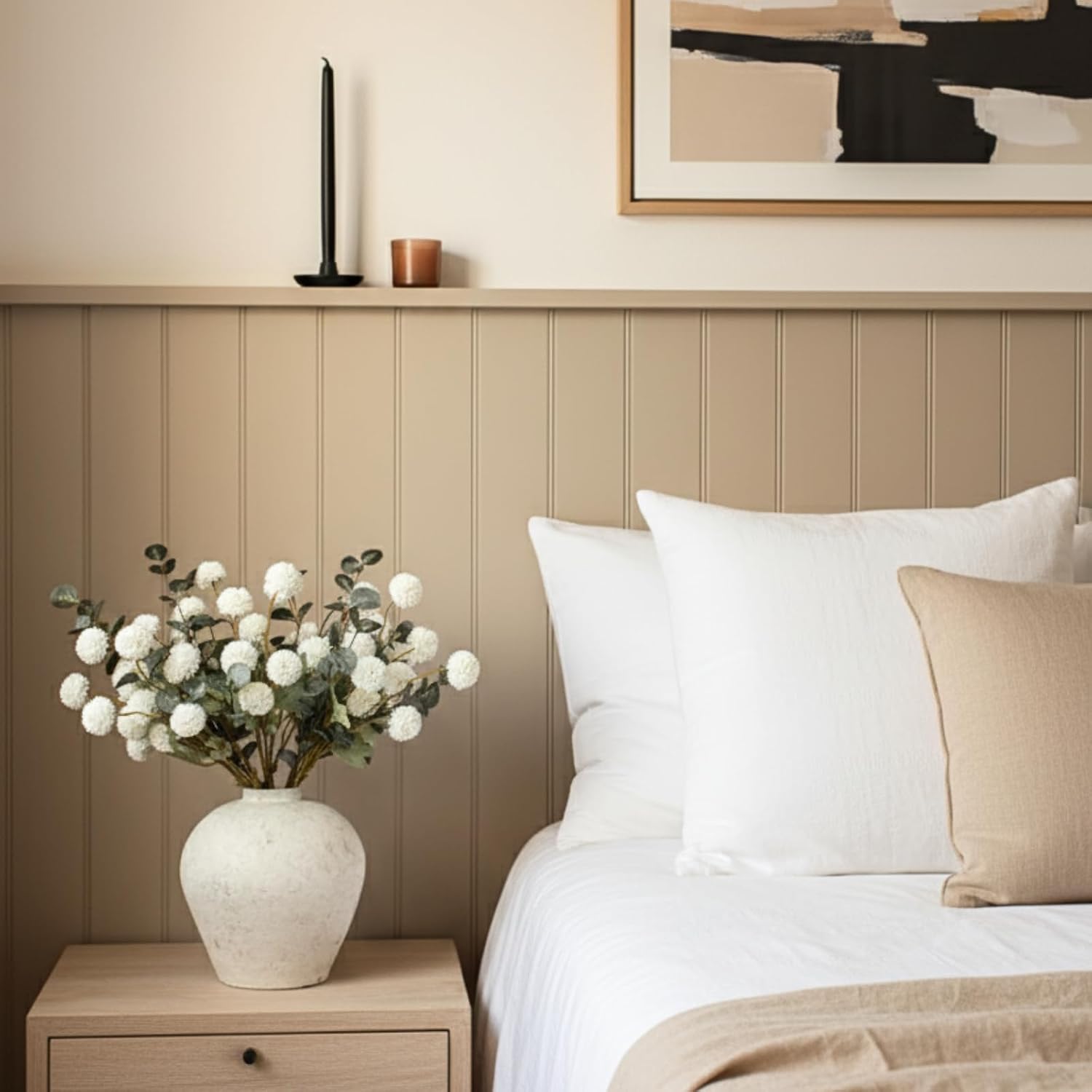
RyddeligHome
$29.99
In stock on Amazon
Check price on AmazonFrequently Asked Questions
How many faux stems do I need to fill a large tall vase without it looking sparse? For a vase with a 5–6 inch mouth, plan on 9–12 stems minimum. Pompon mums and other volumetrically generous heads can get away with 6–7 in a wide-mouth vase. Check the listed stem count against your vase mouth diameter using the table above.
Do I need floral foam or any special supplies to arrange stems in a tall vase? No. For standard tall cylindrical vases, the vase itself holds stems upright. The only optional supply worth considering is a handful of river rock or decorative stones at the base of a clear vase, to conceal the stem ends and add visual weight. Floral foam is a tool for low bowls and shallow containers — not tall vases.
What does it mean when a stem is described as “fully wired” and why does it matter for tall arrangements? Fully wired means a continuous wire runs through every branch, sub-branch, and leaf — not just the main stalk. For tall arrangements, this lets you bend the visible upper portion of each stem outward to create a natural fan shape. Without full wiring, upper branches may droop or collapse, and the arrangement reads as flat and sparse regardless of stem count.
Should I cut stems before I arrange them, or test the height first? Always test height first. Drop the stem into the vase dry, check the proportion (visible stem above the rim should be roughly 1.5× the vase height), and mark the cut point only if trimming is genuinely needed. Most faux stems can also be adjusted by how deep you push them — lowering a stem into the vase raises the effective cut point without any permanent alteration.
Can I mix stems from different product orders in the same vase, or will they look mismatched? Usually yes, with one caveat: match color temperature. Warm beige and cool white-gray can clash even when both are technically “neutral.” The safest approach is to mix within one brand’s color family, or use true neutrals — white, deep green, burgundy — as bridge elements. Varying silhouette (spike + round cluster + trailing element) prevents competition between stems of similar size.
What’s the easiest combination of stems for a complete-looking arrangement if I have no design experience? The pattern reviewers describe most reliably as “professional-looking” without effort: a neutral mum or pompon mum set as the primary volume element, with delphinium stems added for vertical height contrast. The mum handles fullness; the delphinium handles structure. Both are fully wired, both arrive in shapes that require minimal adjustment, and the color families overlap cleanly in the beige-to-cream range. Start with that combination before adding anything more complex.
Sources consulted: The Spruce, “How to Arrange Artificial Flowers”; Apartment Therapy, “The Best Fake Plants That Actually Look Real”; House Beautiful, “How to Make Fake Flowers Look Real”; Floral Design Institute, published curriculum on stem proportion and vase geometry.