September 20, 2026 • Celeste Morrow • 11 min reading time • Prices verified June 6, 2026
Outdoor Faux Flower Bundles Compared: Daisies, Pansies, Lavender, and Geraniums for Planters and Baskets
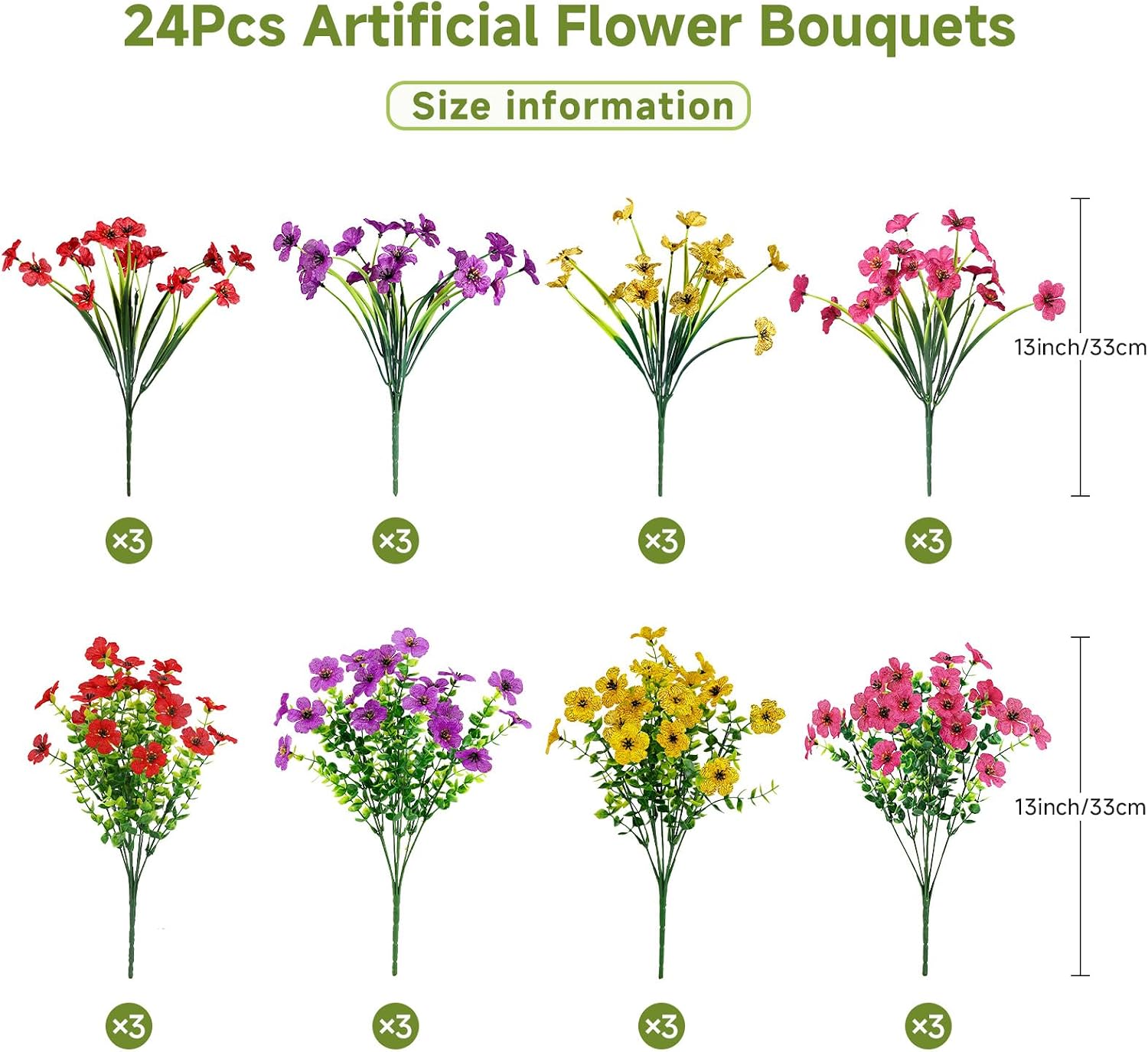
If you’ve ever watched a window box full of real petunias go crispy in a July heat wave — or spent a vacation worrying about whether someone remembered to water the porch planters — outdoor faux flower bundles are the answer that’s finally caught up with the problem. “Faux bundles” are clusters of artificial stems (usually 5–12 stems per bunch, often sold in multipacks) designed to be inserted directly into planters, hanging baskets, or window boxes the same way you’d plant real flowers. The materials vary: cheaper bundles use standard polyester fabric, mid-range packs use PE (polyethylene, a harder plastic that holds petal shape well in heat), and premium options add real-touch latex coatings for softness and natural-looking surface texture. UV stabilization — a chemical treatment baked into the material that slows color fading from sun exposure — is the most important spec to look for on any outdoor bundle. This article compares four of the most-searched bundle flower types — daisies, pansies, lavender, and geraniums — across realism, volume coverage, and planter performance, with honest notes on where each falls short.
| EDITOR'S PICKHananona 2 Set Artificial Outdo… | Mid-tierGeegoods Artificial Plants Flow… | Budget pickAlupssuc 24 Bundles Artificial… | |
|---|---|---|---|
| Bundle count | 24 pcs | 24 pcs | 24 bundles |
| Flower type | Red/purple/yellow | Lavender | Daisy |
| UV resistant | — | ✓ | ✓ |
| Material | — | — | Silk, plastic |
| Hanging basket | ✓ | — | — |
| Monkey grass | — | ✓ | — |
| Price | $44.99 | $23.99 | $15.29 |
| See on Amazon → | See on Amazon → | See on Amazon → |
How the Four Flower Types Stack Up: Detailed Comparisons
Not all faux flower species translate equally well to artificial form, and outdoor use adds a second filter: wind resistance, rain tolerance, and whether the stems hold position in loose potting mix or gravel. The following H3 sections break each flower type into its own comparison block with a tier recommendation at the close.
Daisies: The Most Forgiving Faux Translation
Daisies are among the best faux-to-real translation candidates in the outdoor bundle category. The flower structure is geometrically simple — a flat ray of petals around a central disc — which means even mid-tier PE versions read as convincingly real from normal viewing distances. That structural simplicity also means fewer fine details that can look plasticky up close, making daisies one of the few flower types that performs reliably across all viewing distances. Colors tend to be high-saturation and hold reasonably well through a single outdoor season, particularly in white and yellow variants. For buyers new to outdoor faux arrangements, daisy bundles are the lowest-risk starting point: forgiving geometry, widely available, and easy to layer in hanging baskets or window boxes without a visible seam between real and artificial.
The main limitation is that daisies read as a supporting player rather than a focal flower in formal or structured container arrangements. If your planter design calls for a statement bloom, you’ll want to layer daisy bundles as filler behind a more architecturally complex stem type.
Geegoods
$23.99
In stock on Amazon
Check price on AmazonPansies: High Realism Potential, Higher Execution Dependency
Pansies are a trickier case. Real pansies have a distinctive “face” — a dark center blotch with gradient coloration across the petals — and faux versions that don’t capture this detail read immediately as fake. The better bundle packs pair pansies with filler foliage (eucalyptus is common), which solves two problems at once: the mixed texture breaks up the visual monotony that exposes artificial flowers, and the filler adds density without requiring more flower heads.
As Good Housekeeping has noted in its coverage of outdoor artificial plants, viewing distance is the primary variable in whether a faux planting reads as convincing, and pansies illustrate this principle particularly well. At 6 feet or more, a well-constructed pansy bundle with mixed filler is essentially indistinguishable from a planted container. At arm’s reach, the face-pattern detail is where budget and mid-range versions diverge sharply. Buyers filling elevated window boxes or balcony railings — the most common pansy placement — have significant margin for a mid-range construction tier. Buyers filling front-door entry planters where guests approach within two feet should invest in a premium pansy bundle with printed petal gradients rather than solid-color petals.
The volume requirement for pansies is higher than buyers typically expect: a 13×13-inch square planter needs approximately 20–24 bundles to achieve a full, overflowing appearance — the most common aesthetic target for this container type. That figure is meaningfully higher than the “one pack fills one planter” assumption that drives most first-time orders.
Geegoods
$23.99
In stock on Amazon
Check price on AmazonLavender: Forgiving Form, Honest Close-Range Limitations
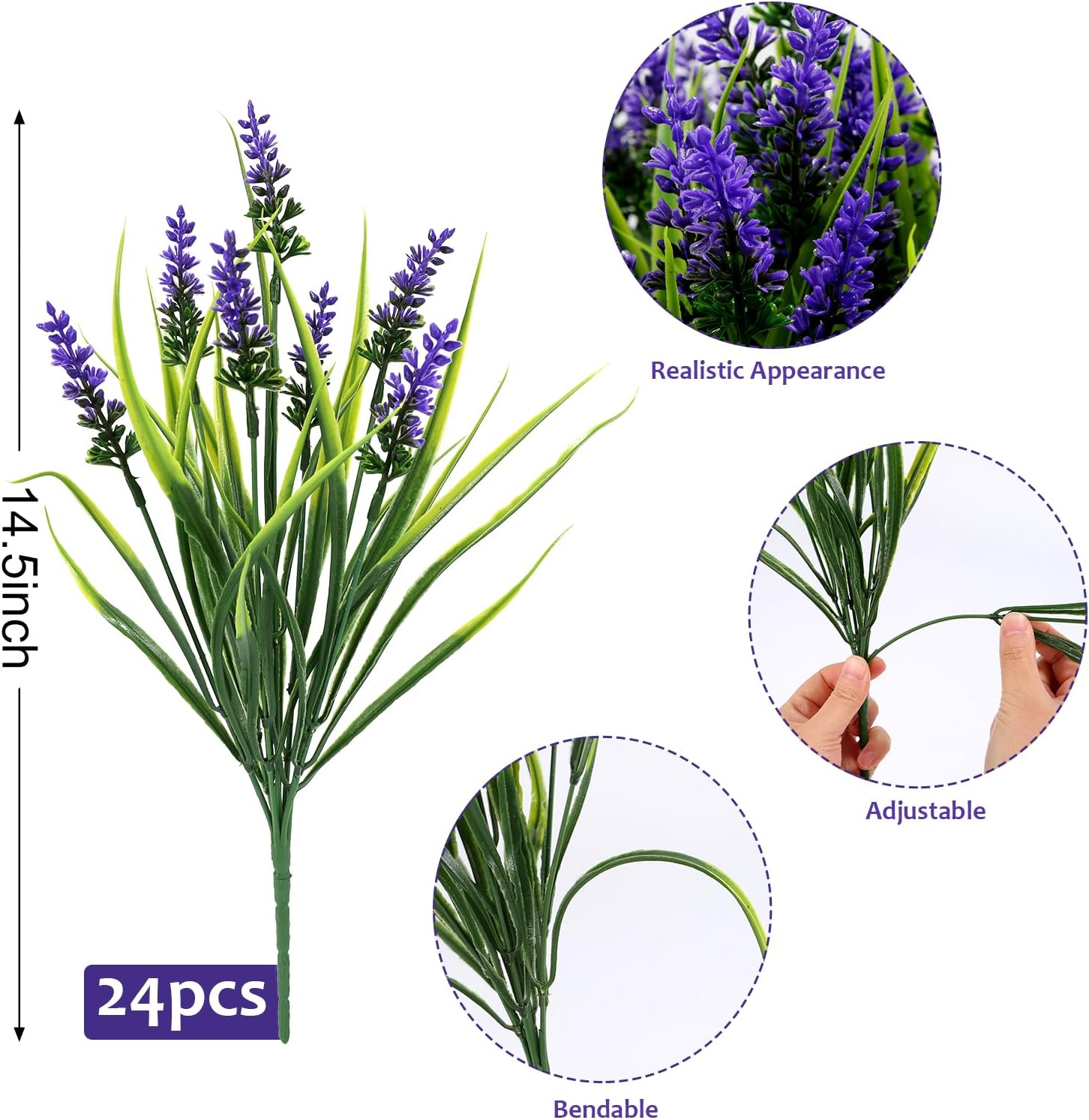
Lavender sits in a unique position among outdoor faux bundles. The flower form — a tight spike of small florets on a slender stem — is actually forgiving of some artificiality because the individual florets are tiny and clustered. Close-range inspection will reveal the plastic surface quality on all but the most premium latex-coated versions; buyers should calibrate expectations accordingly. The honest summary for mid-range lavender bundles is: unconvincing at arm’s length, excellent at 6 feet and beyond.
This is not a failing unique to lavender — The Spruce, in its round-up of best artificial flowers, notes that PE-construction flowers hold shape better in heat but can present a harder surface quality than fabric-petaled alternatives. Lavender’s tight spike form means that harder surface is particularly visible up close. For rooftop terraces, elevated window boxes, or balcony railings viewed from across a courtyard, lavender faux bundles perform beautifully. For ground-level entry planters where guests pause at the door, lavender is best used as a midground or background stem rather than a foreground feature.
The color range for faux lavender bundles skews reliably toward the purple-to-blue spectrum, making them excellent for color-coordinated container designs. Yellows and pale purples fade fastest under direct summer sun, so prioritize mid-to-deep purple variants for south- or west-facing installations.
Alupssuc
$15.29
In stock on Amazon
Check price on AmazonGeraniums: Premium Complexity, Premium Reward
Geraniums occupy the premium end of the outdoor bundle category, partly because the flower head is more complex (a dense cluster of small blooms) and partly because the leaves are distinctively lobed — a shape that’s hard to execute without better tooling and material investment. When the construction tier is right, faux geraniums are genuinely impressive: they read as planted from any distance greater than about four feet, and the leaf detail holds up to moderate close-range inspection in a way that lavender and even pansies do not.
The risk is buying a budget version that shortcuts on leaf detail, which collapses the illusion immediately. House Beautiful’s coverage of faux plants for outdoor spaces flags the leaf-to-bloom ratio as a key realism indicator: arrangements where foliage looks convincing anchor the overall planting even when individual blooms are slightly stylized. For geraniums, this principle is especially operative — the lobed leaf is so recognizable that any approximation reads as artificial. Budget-tier geranium bundles with generic oval leaves are worse investments than budget-tier daisy bundles, because the expectation the buyer brings to a geranium is more specific.
A useful application noted by buyers who manage properties with existing plantings: faux geranium bundles work well as a supplement to live perennials, keeping color visible through die-back periods or between planting cycles. This hybrid approach — faux bundles mixed with live trailing greenery at the container edge — is specifically highlighted in Apartment Therapy’s guide to artificial outdoor plants as a technique that dramatically increases overall realism. The live material at the container edge creates a naturalistic transition that anchors the artificial stems in context.
Hananona
$44.99
In stock on Amazon
Check price on AmazonVolume Math: How Many Bundles Do You Actually Need?
This is where most buyers underorder, especially on their first purchase. The mental model of “one bundle per planter” is almost always wrong for outdoor containers, which are deeper, wider, and need more visual mass than indoor vases.
By the numbers:
| Container type | Approximate bundles needed | Notes |
|---|---|---|
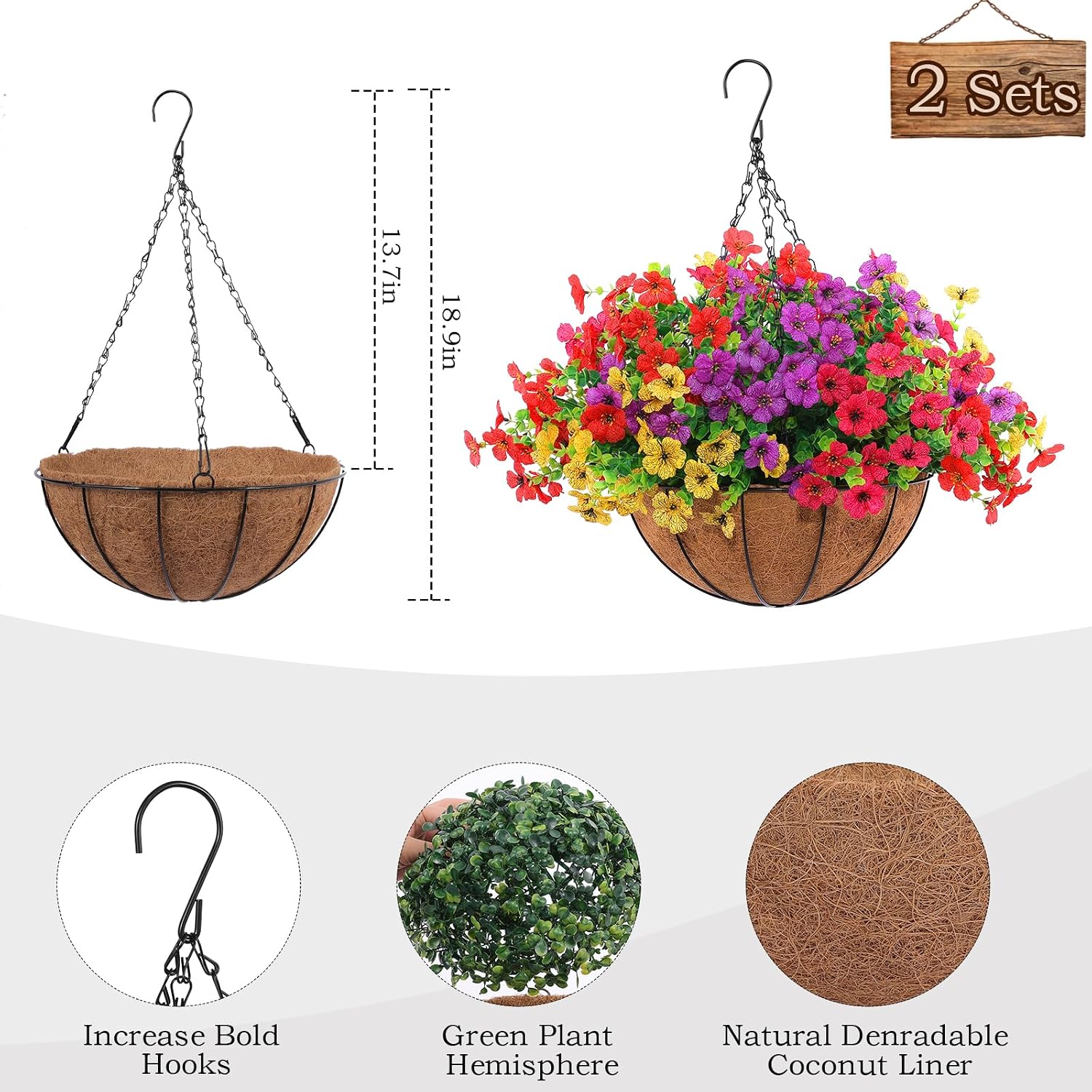
| 10-inch hanging basket | 6–8 bundles | Cascading stems need layering |
| 12-inch hanging basket | 8–12 bundles | Use 10 as baseline; adjust after layout test |
| 13×13-inch square planter | 20–24 bundles | Pansy-with-filler benchmark |
| 16-inch round planter | 14–18 bundles | Depends on stem spread per bundle |
The 24-bundle figure for a 13×13-inch planter reflects field-reported buyer data and aligns with the general practitioner principle that outdoor containers need roughly 1.5–2× the bundle count that looks right in a product photo. Product photos are almost always shot in smaller containers than buyers use, and the hero shot rarely shows the planter from above — which is exactly the angle that exposes sparse coverage.
A practical ordering tip consistent with guidance from Apartment Therapy’s coverage of artificial outdoor plants: always order one extra pack beyond your calculation and keep it unopened. Return rates are low when the order is right-sized, and having a reserve pack prevents the specific frustration of a 90%-full basket that needs only three more stems to look complete.
Realism by Viewing Distance: The Honest Decision Frame
This is the conversation that doesn’t happen enough in product listings. Faux outdoor bundles are not a uniform product category — they exist on a spectrum, and where they land on that spectrum determines what uses they’re actually suited for.
Good Housekeeping’s coverage of outdoor artificial plants draws a consistent distinction: viewing distance is the primary variable in whether a faux planting reads as real. The Spruce’s round-up of best artificial flowers reinforces this, noting that PE-construction flowers hold shape better in heat but can look harder-surfaced than fabric-petaled alternatives. House Beautiful’s faux plant coverage specifically notes that mixing artificial bundles with real trailing greenery at the container edge dramatically increases overall realism — an approach that works with all four flower types in this comparison.
Here’s the practical decision frame:
- Ground-level planters at entry points (front doors, restaurant stoops, retail entrances): viewers approach within 2–3 feet. Prioritize simpler flower geometries (daisies) or invest in a premium construction tier for pansies and geraniums.
- Elevated window boxes or balcony railings: 6–15 feet of typical viewing distance. Almost any mid-range bundle reads convincingly at this range. Lavender and pansies are particularly well-suited here.
- Rooftop or terrace installations viewed from street level: 20+ feet. Bundle density and color saturation matter more than fine detail. All four flower types perform well.
- Hanging baskets on covered porches: Close-range but often lower-light. The light condition softens perceived artificiality significantly; this is the most forgiving placement for budget-tier bundles.
UV, Weather, and Storage: What the Data Actually Shows
A note of honest restraint: no buyer review cluster for outdoor faux bundles currently contains multi-season longitudinal data. Most reviews are written within the first season of use, sometimes within weeks of purchase. Claims of “3–5 year outdoor lifespan” that appear in some product listings are manufacturer-stated specs, not field-verified. Treat them as best-case figures under ideal conditions.
What buyers do consistently report:
- Rain does not damage stem attachment on better-constructed bundles, provided planters have drainage holes that prevent water pooling around stem bases.
- Wind causes stem displacement in loose planters — not structural damage, but cosmetic misalignment. Floral foam (a dense green foam block used to anchor stems in arrangements, available at craft and garden stores) provides significantly better stem stability than gravel or potting mix alone.
- Color fading is reported anecdotally after one full summer of direct southern or western exposure, with yellows and purples most vulnerable. Apartment Therapy’s guide to artificial outdoor plants notes that UV stabilization is a spec worth verifying at purchase, not assumed.
On storage: buyers who pull bundles at end of season, store them loosely in a lidded bin, and reuse the following year report acceptable condition — some petal flattening on fabric types, minimal degradation on PE. The cost-per-season math favors faux even conservatively: a multipack that performs for two seasons outperforms a comparable annual bedding-plant budget in year two.
Frequently Asked Questions
How many bundles do I need to fill a standard 12-inch hanging basket? Most practitioners land at 8–12 bundles for a 12-inch basket, depending on stem spread and whether you want a cascading or mounded look. Use 10 as your baseline and test layout before securing stems permanently.
Will bundles stay put in a planter without foam? In loose potting mix or gravel alone, expect stem drift — especially in wind. Floral foam, or a foam base topped with gravel for aesthetics, gives the most secure anchor. Buyers who skip this step consistently report needing to reposition stems after rain or strong winds.
How realistic do faux outdoor bundles look up close vs. from the street? Most mid-range bundles are streetview-convincing and close-range approximate. The honest calibration for lavender and pansies: expect “convincing from 6 feet, visible as artificial at arm’s length” unless you’re buying a premium latex-coated tier. Daisies are the most forgiving at close range due to geometric simplicity.
Can I store and reuse these next season? Reviewers broadly report successful reuse after off-season storage in a cool, dry location. PE-construction bundles hold shape better than fabric types. Expect minor petal compression on fabric varieties; reshape by hand before reinstalling.
Do faux flower bundles hold up in rain and wind? Rain: generally fine with proper planter drainage. Wind: stems displace rather than break, and foam anchoring resolves most of this. The typical failure mode is cosmetic drift, not structural failure.
The Decision Rule
If you’re outfitting planters primarily viewed at 6 feet or more — elevated window boxes, balcony rails, rooftop terraces — order by color saturation and bundle density, and all four flower types are viable. Lavender and pansies are the strongest performers at this range. If you’re filling ground-level entry planters where visitors approach within arm’s reach, bias toward daisy bundles for their close-range geometric simplicity, or invest in a premium construction tier for geraniums. In either case: order 1.5× your instinct, anchor in floral foam, mix faux bundles with live trailing greenery at the container edge when possible, and treat multi-season durability claims as aspirational until field data catches up with the product category.