June 26, 2026 • Celeste Morrow • 9 min reading time • Prices verified June 6, 2026
UV-Resistant Outdoor Faux Flowers: What 'No Fade' Actually Means Before You Buy
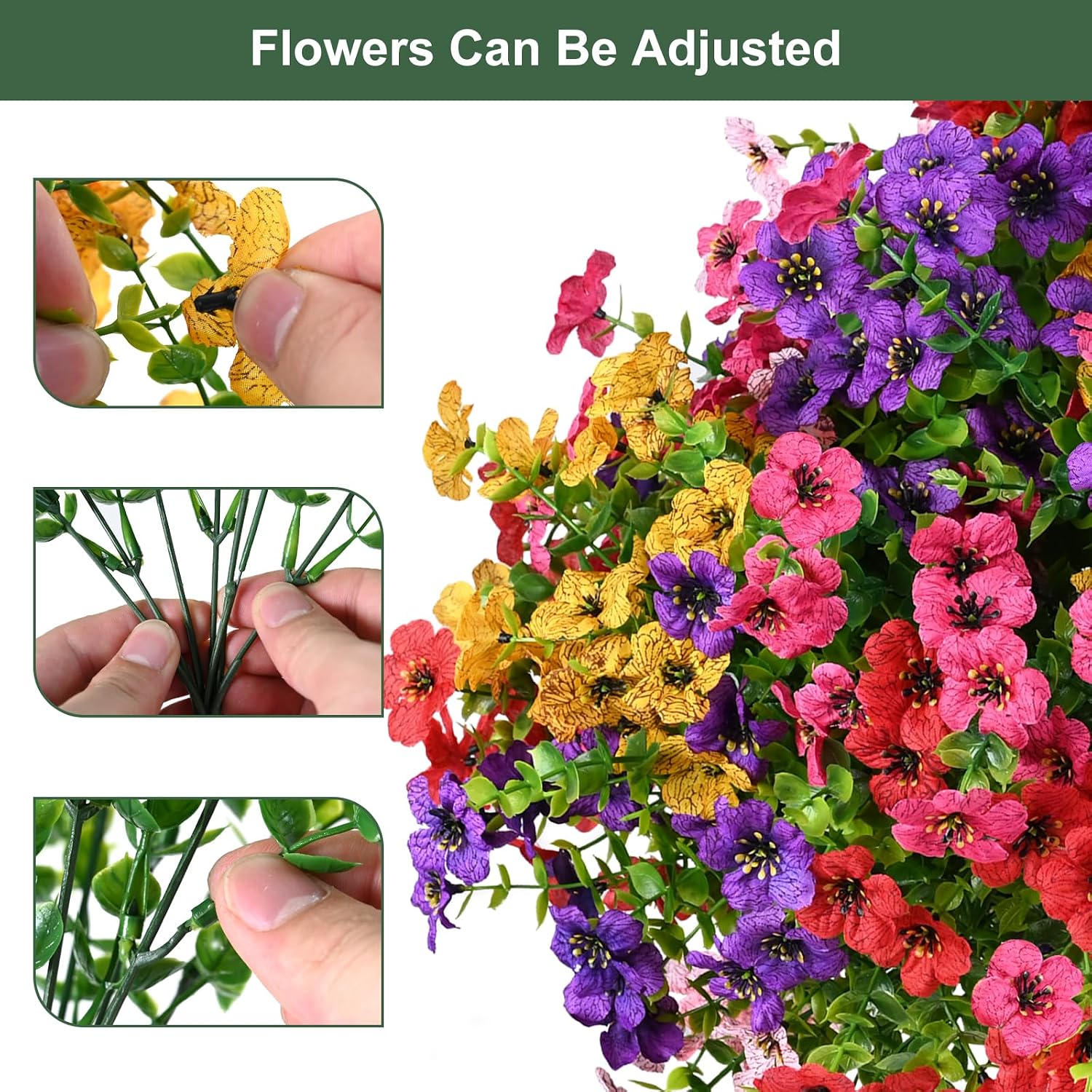
If you’ve ever bought “outdoor-safe” artificial flowers, arranged them beautifully on a patio or balcony, and returned two months later to find bleached, brittle stems where your lush display used to be — you already understand the problem. The phrase “UV-resistant” on a product listing sounds reassuring, but it doesn’t mean much on its own, because UV resistance exists on a wide spectrum, and most brands don’t tell you where on that spectrum their product actually sits. UV rays (ultraviolet light from the sun) are the primary reason outdoor faux flowers degrade: they break down pigments in the fabric or plastic, causing colors to shift, materials to stiffen, and surfaces to crack. This guide is here to help you decode those claims before you spend — whether you’re buying a $15 stem bundle for a window box or a $400 arrangement for a boutique hotel terrace.
Once you have that baseline, we’ll go deeper: what material grades actually hold up, how long “rated for outdoor use” realistically translates into calendar months, and the exact questions to ask any supplier before signing off on a volume order.
What “UV-Resistant” Actually Means — and What It Doesn’t
Here’s the short version: UV resistance is an additive property, not an intrinsic one. Manufacturers incorporate UV stabilizers — chemical compounds blended into polyethylene (PE), polyester fabric, or PVC during production — that absorb or scatter ultraviolet radiation before it breaks down the dye molecules underneath. The better the stabilizer concentration and the more UV-opaque the outer coating, the longer the product holds color and structural integrity.
The phrase “UV-resistant” in a product title tells you only that some amount of UV stabilizer is present. It does not tell you:
- What UV exposure level was used in testing (direct sun in Phoenix versus dappled shade in Seattle are not the same environment)
- Whether the rating covers the stem, the leaf material, and the flower head equally — or just one component
- How many hours of direct sunlight the product was rated against before measurable fading occurred
The Spruce’s roundup of outdoor artificial plants notes that reviewers consistently distinguish between products described as “UV-resistant” and those tested or rated to a specific hour threshold — and that the distinction matters enormously for sun-exposed installations. Good Housekeeping’s guidance on outdoor artificial plants echoes this: products without a stated hour rating are essentially self-certified by the brand, with no third-party verification.
What you want to see instead: A manufacturer rating of 1,500 to 2,000+ UV hours, or a reference to ASTM G154 or ISO 4892 testing standards (these are accelerated weathering test protocols used to simulate sunlight exposure). Very few consumer-grade listings include this, but specialty trade suppliers — particularly those serving hospitality and event design — sometimes do, and it’s worth asking directly.
Material Grades: Which Plastics and Fabrics Actually Hold Up Outdoors
Not all faux flower materials age the same way under UV exposure. Here’s the honest ranking, from most durable to least, based on published material science and aggregated owner reporting across professional design forums and retailer review sections.
Polyethylene (PE) — best for structural longevity PE is the gold standard for outdoor artificial foliage and increasingly for flower heads. It’s injection-molded rather than fabric-wrapped, which means UV stabilizers can be blended uniformly through the entire material rather than applied as a surface coating. Owners of PE-based outdoor arrangements consistently report color holding over two to three full outdoor seasons, particularly in moderate sun climates. The trade-off: PE doesn’t achieve the soft drape or fine petal detail of fabric. It’s exceptional for foliage, hedges, and tropicals; less convincing for delicate blooms like ranunculus or sweet peas.
UV-stabilized polyester fabric — mid-range performer This is the most common material in the mid-price faux flower category ($40–$150 range). Polyester takes UV stabilizer treatments reasonably well, but because the dye sits on the fiber surface rather than through-and-through, fading typically begins at the petal edges — the thinnest, most exposed sections — and works inward. Apartment Therapy’s coverage of patio faux plants notes that reviewers frequently report “edge bleaching” on fabric florals within one season of heavy direct sun, even on products labeled outdoor-safe. If you’re using polyester-fabric flowers outdoors, semi-shaded placement extends their realistic life significantly.
Silk (polysilk) — indoor material, full stop High-end polysilk, the material that makes premium indoor arrangements look breathtaking, is not engineered for UV exposure. Its realism comes from ultra-fine weave densities and multi-layer dyeing techniques that UV radiation degrades quickly. Architectural Digest’s feature on designer-grade artificial plants makes this point directly: even brands like Winward Silks, whose indoor arrangements are widely respected for realism, don’t position their silk products for outdoor use. Using polysilk outdoors to save money almost always results in a faster replacement cycle — and a worse aesthetic outcome at the point of replacement.
Real-touch latex — avoid outdoors Real-touch latex (sometimes listed as “real-touch TPR”) is engineered for tactile realism indoors: the soft, slightly waxy feel that makes petals feel almost biological. Outdoors, latex degrades under UV in two ways — the pigment fades and the material itself begins to chalk and crack. Review aggregation on major retailers shows owners of latex florals placed outdoors reporting visible degradation within 60 to 90 days in full sun climates.
The Math: Hours of Sun vs. Product Lifespan
This is where many buyers underestimate their actual exposure load. Let’s run through a concrete scenario.
By the numbers:
- Average daily peak UV hours in a mid-latitude sun climate (Dallas, Atlanta, Los Angeles): 5–7 hours
- Days in a typical outdoor display season (April–October in the US): ~210 days
- Total seasonal UV hours at that rate: 1,050–1,470 hours per season
- Most consumer-grade “UV-resistant” faux florals: rated or reviewed to hold color for approximately 500–800 hours of direct exposure
- Premium PE-based or UV-stabilized commercial-grade florals: 1,500–2,500+ hours
What that math says practically: a consumer-grade “UV-resistant” product placed in full afternoon sun will likely show meaningful fading within a single outdoor season. A commercial-grade PE product in the same placement may hold for one-and-a-half to two full seasons before replacement becomes necessary.
For event designers pricing out a patio wedding or hotel terrace installation, this math is a cost-per-season argument, not just a quality argument. If a premium UV-rated arrangement costs 2.5x a consumer-grade one but lasts three seasons versus one, the total cost-per-season is actually lower — and the aesthetic consistency across a hospitality account’s annual renewal cycle is substantially better.
Reading Product Listings for Real UV Claims
Since most product pages won’t hand you a clean UV hour rating, here are the signals — positive and negative — to scan for when evaluating a listing or spec sheet.
Positive signals:
- “Rated for X hours of direct sunlight” or “tested to ASTM G154” — even an approximate hour rating indicates the brand is measuring rather than guessing
- “UV stabilizers added during manufacturing” (especially for PE products — this means through-body protection, not surface coating)
- Color options listed as “colorfast” with specific climate or placement guidance
- Supplier offers replacement or fade warranties — brands that stand behind fade claims in writing are signaling confidence in their materials
- Product is listed as suitable for “direct sun” rather than just “outdoor use” or “all-weather” — the latter two may only mean moisture resistance, not UV protection
Red flags:
- “UV-resistant” in the title or bullets with no further specification anywhere in the listing
- Product described as “weather-resistant” or “weatherproof” without any mention of UV — these terms often refer only to moisture and wind, not fading
- Real-touch or silk materials listed as “outdoor safe” — as covered above, this should be treated skeptically without a specific UV rating
- No clarity on whether the UV protection applies uniformly to leaves, stems, and flower heads, or only to one component
Good Housekeeping’s product evaluation approach specifically flags “weather-resistant” as a term that buyers frequently conflate with UV protection, noting that the two properties are engineered separately and a product can excel at one while failing the other.
Supplier Questions Worth Asking Before a Volume Order
If you’re sourcing at volume — wedding arches, hotel balconies, retail visual merchandising — these are the questions that separate professional sourcing from guesswork:
-
“What is the rated UV hour threshold for this product, and was it tested in direct or indirect sun conditions?” Any reputable trade supplier should be able to answer this or escalate to the manufacturer.
-
“Is the UV stabilization through-body or surface-applied?” Surface treatments can be abraded by rain, cleaning, and handling. Through-body stabilization is more durable across the product’s lifecycle.
-
“Does the rating apply equally to the flower heads, leaves, and stem wrap?” Multi-component products often have inconsistent UV protection across their parts. Knowing the weakest link helps you plan maintenance cycles.
-
“What’s your replacement or fade policy for commercial installs?” Brands like Afloral and Nearly Natural have reasonably clear return policies documented on their sites; for premium or custom orders, get fade warranties in writing before finalizing the purchase order.
-
“Have other hospitality or event clients used this product in full-sun outdoor placements? Can you share outcome data or case references?” Reputable trade suppliers have this information. If the answer is a deflection, that tells you something.
The Decision Rule
If you internalize nothing else from this guide, make it this framework:
-
If placement is shaded or indirect sun (covered porch, north-facing balcony, interior atrium with skylight): UV-stabilized polyester fabric florals in the $40–$120 range are a reasonable choice. Monitor for edge fading seasonally and plan to refresh every two to three years.
-
If placement is direct sun for more than four hours per day: Require a PE-based or commercial-grade product with a documented UV hour rating above 1,500 hours. Budget accordingly — this typically means $80–$200+ per arrangement — and treat it as a two-to-three season asset.
-
If placement is full direct sun in a high-UV climate (Southwest US, coastal Florida, Southern Europe) for a permanent or semi-permanent install: Only PE through-body UV-stabilized products belong here. Expect realistic color retention for one to two seasons maximum even with premium materials, and price your client quotes to include a seasonal refresh cycle.
-
If you’re sourcing real-touch or polysilk for any outdoor context: Don’t. Regardless of what the listing says. The math and the review patterns both say the same thing — these materials are indoor products being sold into outdoor contexts by listings that are optimistic at best.
The “no fade” claim on a product page is a starting point for a conversation, not a conclusion. Ask the next question. Run the hour math for your specific placement. And when in doubt, buy a single stem before committing to a full volume order — not to test it yourself, but to have the physical product in hand when you push the supplier for documentation.