August 20, 2026 • Celeste Morrow • 10 min reading time • Prices verified June 6, 2026
Preserved Roses vs. Eternal Dome Roses vs. Velvet Box Sets: Which Gift Actually Lives Up to the Price
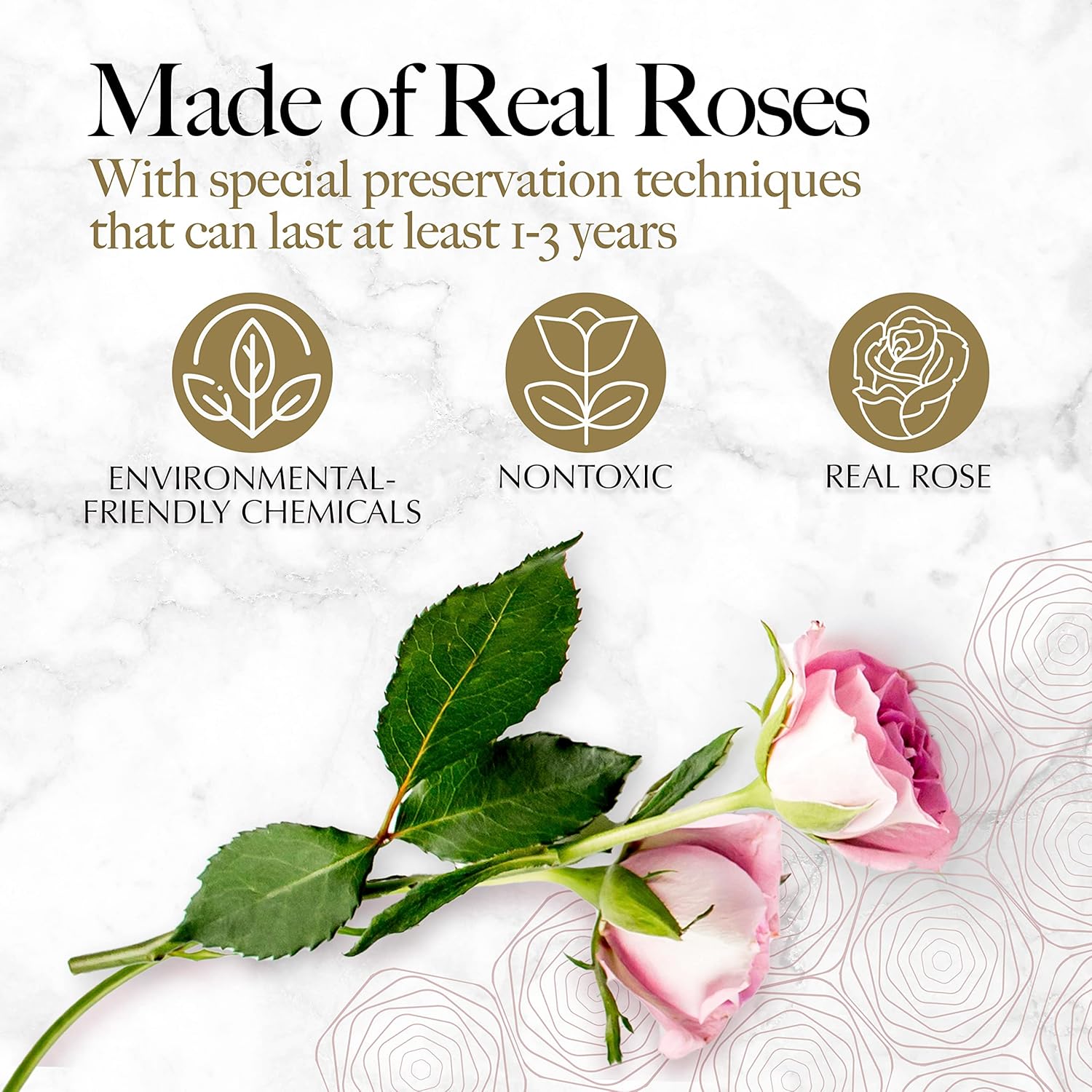
If you’ve ever typed “roses that last forever” into a search bar, you already know the product category exists — but the naming is genuinely confusing. Preserved roses are real roses that have been harvested at peak bloom, then treated with a glycerin-and-dye solution that replaces the plant’s natural moisture, leaving a petal that stays soft, pigmented, and three-dimensional for months or years without water. Eternal dome roses — the glass-cloche single stem that reads unmistakably as a Beauty and the Beast reference — are usually also preserved roses, just sold individually under a glass cover as a standalone display object. Velvet box sets are preserved roses arranged in quantity (sometimes 9, 16, 25, or 50 stems) inside a rigid, fabric-wrapped presentation box. The roses inside may be preserved, foam, or silk depending on price point. All three formats get lumped together in gift searches, but they serve very different emotional and functional purposes. This article untangles them: what each format actually delivers, where the experience can fall short, and a clear decision rule for which one fits your situation.
| EDITOR'S PICKGLAMOUR BOUTIQUE 27 Flower Fore… | Mid-tierForever Preserved Rose - Eterna… | Budget pickImpouo 16-Piece Preserved Rose… | |
|---|---|---|---|
| Rose count | 27 | — | 16-piece |
| Container type | Heart box | Glass dome | — |
| Container size | — | 9 in | — |
| Display format | Box | Dome | — |
| Price | $54.98 | $39.99 | $36.99 |
| See on Amazon → | See on Amazon → | See on Amazon → |
What You’re Actually Buying in Each Format
The three formats share a category name but not a use case. Understanding the structural difference between them — not just the visual one — is what separates a gift that lands from one that reads slightly off even when the roses are beautiful.
Glass Dome Single Rose
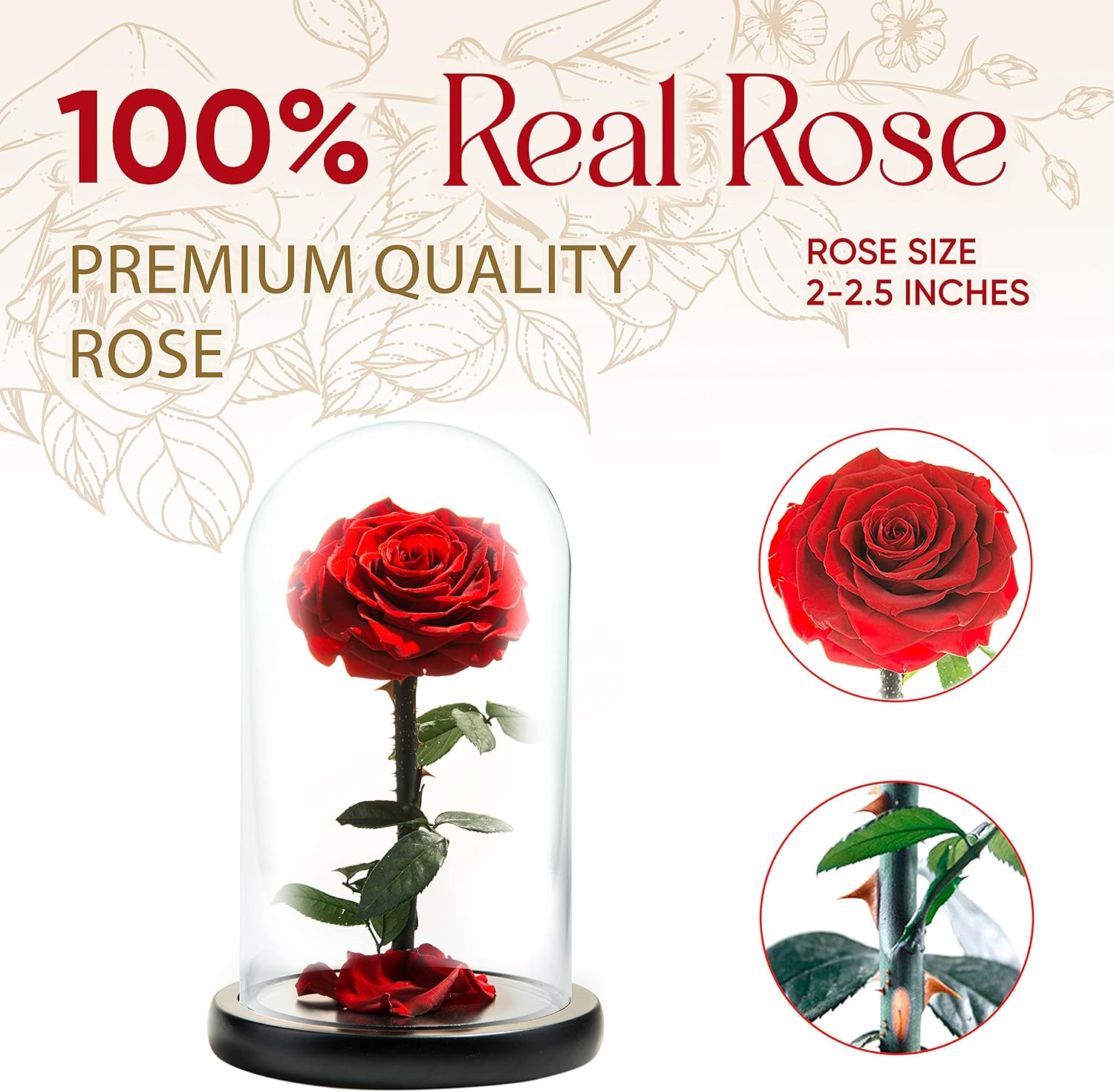
The glass dome format lives in its own use-case lane. Reviewers consistently describe it not as a floral gift but as a permanent comfort object — a solitary display piece whose glass enclosure does genuine functional work, blocking the two main degradation accelerators: dust accumulation and humidity fluctuation. The Spruce’s overview of preserved versus artificial flowers notes that enclosed environments meaningfully extend display life compared to open arrangements, which is why the dome format earns its premium over a bare stem at a similar price point.
The rose inside is almost always a single preserved stem (sometimes a high-quality silk stem at lower price points). The product succeeds when the recipient needs something that signals “I’m thinking about you durably” — not just “I’m marking this occasion.”
Trade-off: The dome format is emotionally legible to almost any recipient, but it is not scalable. You cannot build a centerpiece from it, and it reads incomplete as part of a set. It is a solitary object, and that is both its strength and its limitation.
Impouo
$36.99
In stock on Amazon
Check price on AmazonHeart Box and Round Box Sets (9–25 Roses)
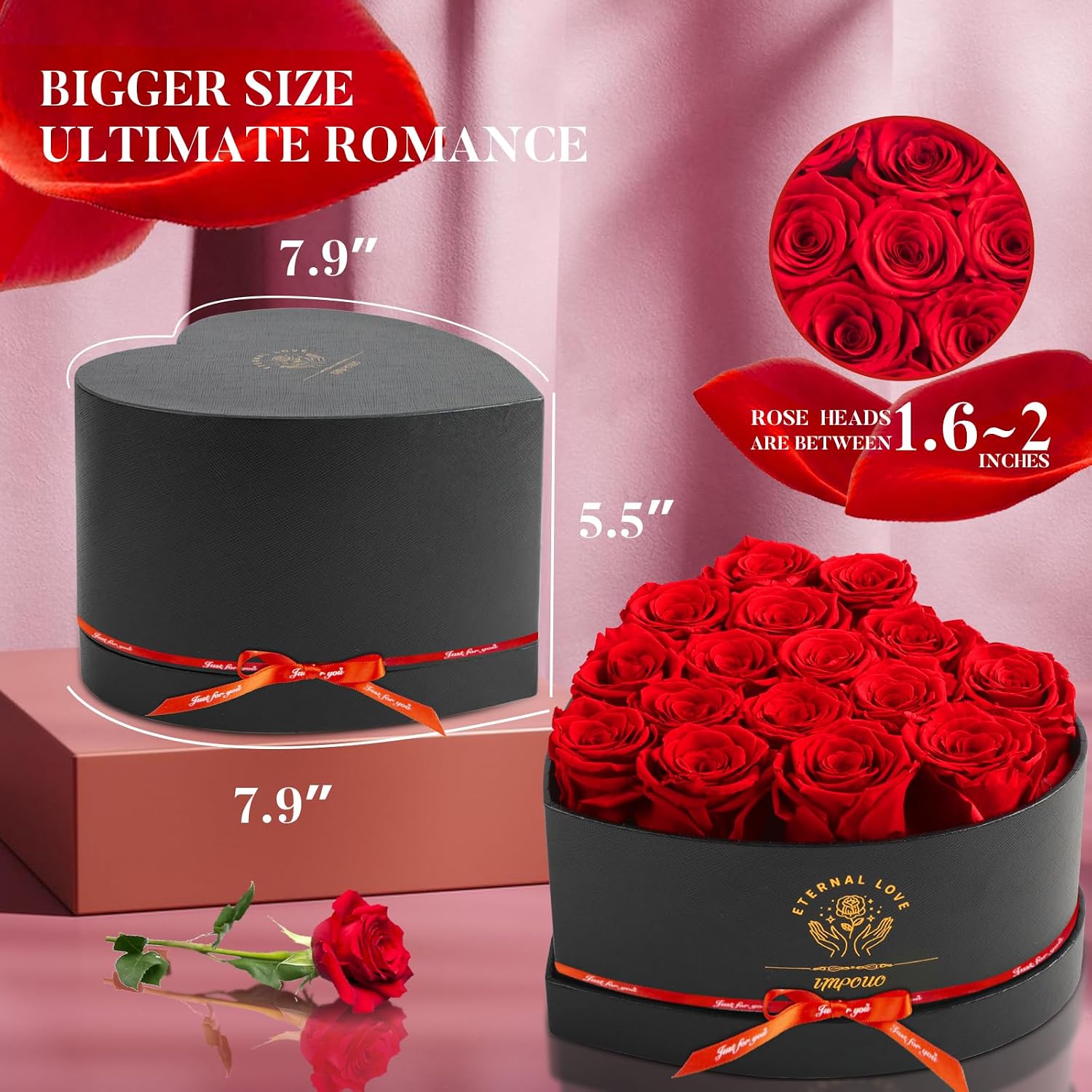
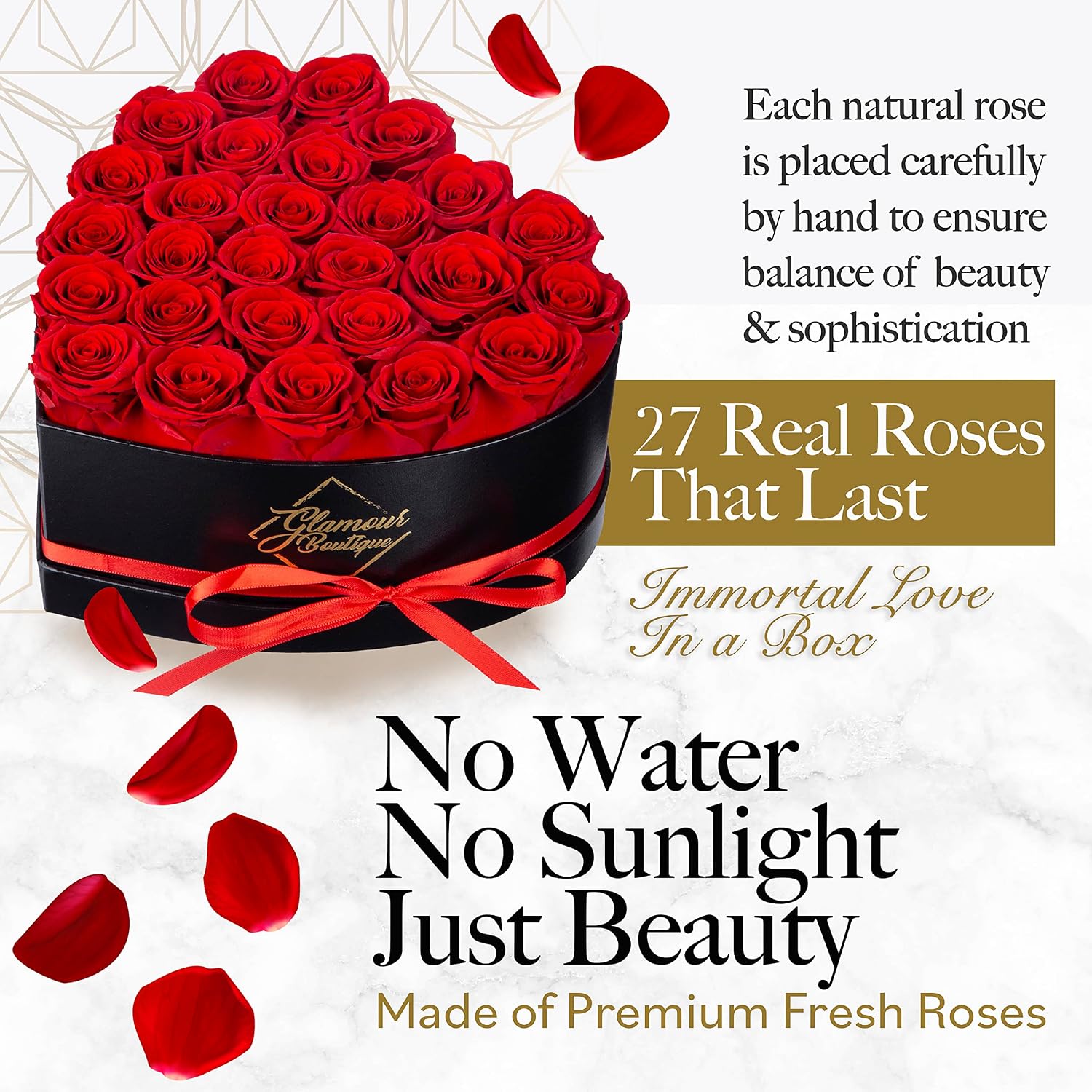
These are the format most people picture when they search “luxury rose gift.” The roses are arranged tightly in a grid inside a rigid presentation box — heart-shaped, round, or square — lined in satin or velvet. At the $60–$150 price tier, the roses are typically preserved real roses; below $40, they are more likely foam or high-density silk roses designed to mimic the preserved look.
The packaging lands the emotional impact before the recipient has touched a single petal. This is not a criticism — it is actionable information. If your gift moment is high-stakes and the recipient will open it in front of others (proposal, anniversary reveal, graduation), the heart box format is engineered for exactly that beat. Brides’ editorial overview of preserved rose gifting frames these box formats explicitly as theatrical presentation objects, noting that the unboxing experience is as much the product as the roses themselves.
Trade-off: The tight arrangement means the roses are essentially static display items. They are not meant to be removed and rearranged, and the box dimensions make them difficult to integrate into a home décor setup once the initial display novelty fades. Longevity for the recipient matters less here than emotional impact on receipt.
Forever
$39.99
In stock on Amazon
Check price on AmazonVelvet Box Sets (16–50 Roses)
The velvet box set scales up quantity while maintaining the presentation logic of the heart box. The 50-rose velvet box format in particular has generated a buyer-surprise pattern worth flagging: some recipients report a noticeable fragrance on arrival, which surprises buyers who hadn’t expected preserved roses to retain scent. This is a genuine but variable product feature — the glycerin preservation process can trap residual fragrance, though intensity and duration vary significantly by rose variety and production method.
Good Housekeeping’s flower preservation guide notes that fragrance compounds are among the first volatiles lost in any drying or chemical preservation process, so scent retention in preserved roses should be treated as a possible bonus rather than a reliable primary feature. If fragrance is central to your brief, pairing the box with a separate scented product is more dependable than relying on the roses alone.
Mid-tier velvet box sets — the 16-piece format in particular — sit at an interesting credibility point. Reviewer language across this category consistently signals buyers entering with moderate expectations and being exceeded on realism for the price. That asymmetry is genuinely useful when the recipient doesn’t know the price point. If you need volume (table runner, multiple small gifts, event favors) and visual realism matters more than provenance, mid-tier velvet box sets deliver disproportionate return. Apartment Therapy’s feature on preserved flowers reinforces this: the publication frames preserved and high-quality artificial roses in box formats as “significantly extended” gifts rather than indefinitely permanent ones — a distinction that sets accurate expectations without underselling the product.
Trade-off: At lower price tiers inside this format, roses may be foam or silk rather than preserved. The visual difference at distance is minimal; the tactile difference up close is real. Know which you’re sourcing before committing.
GLAMOUR
$54.98
In stock on Amazon
Check price on AmazonThe Longevity Question Nobody Answers Honestly
No reviewer across any of these formats provides a specific month count for degradation, which is the single most common pre-purchase question in this category. Here is what aggregated sourcing and brand care documentation actually support:
Preserved roses in enclosed or low-light conditions: commonly cited range of 1–3 years before visible color fade, per multiple preserved flower brand care guides.
Preserved roses in open display, ambient indoor light: 6–12 months is a realistic expectation before softness and pigment begin to degrade noticeably.
Foam or silk roses in the same formats: 3–5+ years for structural integrity, but without the tactile realism of preserved petals.
UV exposure (direct sun): The Spruce’s overview of preserved flower care identifies UV light as the single most reliable accelerator of color degradation in preserved roses. Direct sun can compress the color-fade timeline from months to weeks. Bright indirect light is acceptable for medium-term display; the glass dome format earns its keep here precisely because the enclosure reduces both UV exposure and humidity fluctuation simultaneously.
The honest framing — which Apartment Therapy’s preserved flower feature captures well — is that preserved roses are “significantly extended” cut flowers, not indefinitely permanent objects. That distinction matters when you’re setting expectations for a client or writing product copy.
Format-to-Occasion Decision Framework
Choosing the wrong format for the occasion creates a gift that reads slightly off even when the roses themselves are beautiful. The formats are not interchangeable.
Glass dome: Best for one-to-one, emotionally weighted moments — recovery from illness or surgery, long-distance relationship milestones, a single considered “I’m thinking of you” statement. The object reads as deliberate and solitary. It works as a desk or nightstand piece and requires nothing from the recipient beyond placing it somewhere.
Heart or round box (9–25 stems): Optimized for high-emotional-stakes reveal moments — proposals, anniversaries, Valentine’s Day, significant birthdays. The format is inherently theatrical. It requires the recipient to be present for the unboxing, or the impact is partially lost. Brides’ editorial overview of preserved rose formats specifically identifies the heart box as the strongest format for proposal and anniversary gifting precisely because the presentation structure front-loads the emotional signal.
Velvet box set (16–50 stems): The practical choice for event stylists or for gifts where quantity signals generosity more effectively than a single object. Also the right format when the recipient will redistribute the roses — pulling a few for a vase, staging them across a room, or using them as décor elements rather than a single display piece.
Foam or silk alternatives in box formats: Worth considering when longevity is the primary brief and scent or tactile realism is less important. Good Housekeeping’s preservation guide notes that silk and foam alternatives now photograph nearly identically to preserved roses at many price tiers — a relevant consideration when the gift will be documented on social media rather than handled repeatedly.
Frequently Asked Questions
How long do preserved roses actually last before they degrade or lose color? The honest range, based on brand care documentation and aggregated reviewer reporting, is 1–3 years in low-light, low-humidity, enclosed or stable conditions. Open display in ambient indoor light compresses that to 6–12 months before visible softening or color shift. Direct sunlight shortens it further. No format is indefinite.
Do preserved roses have a scent, and how long does it last? Some preserved roses retain a faint natural fragrance on arrival. However, as Good Housekeeping’s flower preservation guide confirms, fragrance compounds are among the first volatiles to dissipate in any drying or chemical preservation process. Treat scent as a possible bonus rather than a reliable feature. If fragrance is the primary brief, a separate scented product paired with the roses is more dependable.
What is the difference between preserved roses and artificial silk or foam roses? Preserved roses are real botanical material — they began as living roses and were chemically processed to arrest decay. Silk and foam roses are manufactured from synthetic or fabric materials to simulate the visual appearance of a rose. The Spruce’s comparison of preserved versus artificial flowers notes that preserved roses offer more convincing petal texture at close range, while high-quality silk and foam alternatives outperform on longevity and UV resistance.
Is the color in the box accurate to what arrives? This is a legitimate concern with preserved roses specifically. The glycerin-dyeing process can produce subtle batch-to-batch variation, and product photography is often shot under optimized lighting. Reviewer patterns across box formats suggest that deep jewel tones (burgundy, navy, deep purple) tend to photograph closest to actual product. Pastels and whites show more variation. If color accuracy is critical and you cannot see the product first, requesting a single-stem sample where the brand offers one is a reasonable precaution.
Can I display preserved roses in a sunny window? Avoid it. UV exposure is the single most reliable accelerator of color degradation in preserved roses, per The Spruce’s preserved flower care overview and multiple brand care guides. Direct sun should be avoided entirely. Bright indirect light is acceptable for medium-term display. For maximum longevity, an enclosed glass cover — as in the dome format — significantly reduces both UV and humidity exposure.
The Decision Rule
If the gift moment is singular, emotionally weighted, and meant to endure on a desk or shelf: the glass dome is the right format. It signals permanence in a way a box of roses cannot, and the enclosure does real preservation work.
If the moment is high-stakes and theatrical, where the unboxing is the experience: a heart or round box in the 16–25 stem range at a preserved-rose price point is engineered for exactly that moment.
If you need volume, flexibility, or a gift the recipient can interact with beyond static display: the velvet box set scales appropriately, and mid-tier options consistently exceed buyer expectations on realism for the price.
The one thing all three formats share: they are not indefinitely permanent. They are meaningfully extended. Price accordingly, present that expectation honestly if you’re sourcing for a client, and the format you choose will land correctly for its moment.