September 3, 2026 • Celeste Morrow • 9 min reading time • Prices verified June 6, 2026
Preserved Roses as Gifts: What to Expect at Every Price Point Before You Order
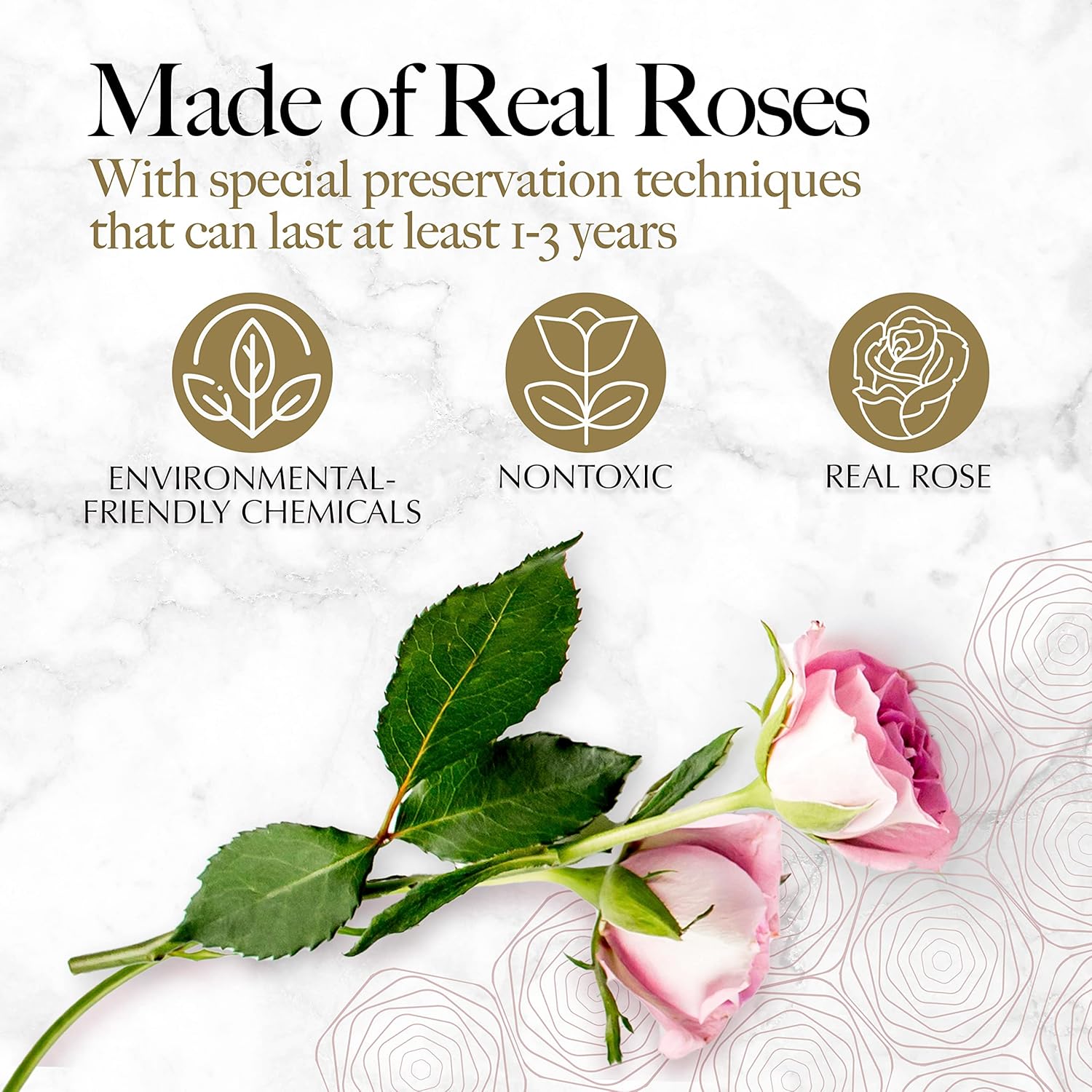
If you’ve been looking at rose gifts online and noticed listings that say “preserved” alongside prices ranging from $18 to $300, it’s fair to wonder: what exactly is a preserved rose, and is this category worth the premium over a fresh bouquet? Here’s the short answer. Preserved roses are real roses — grown, cut, and then treated with a glycerin-based solution that replaces the plant’s natural moisture, locking the bloom in its peak-open state without water, refrigeration, or any ongoing care. The result looks and feels genuinely floral (soft petals, natural color gradients, often a light scent) but behaves more like a decorative object than a perishable flower. They are not the same as silk or artificial roses, which are manufactured from fabric, latex, or plastic. That distinction matters enormously when you’re choosing a gift or stocking inventory, and conflating the two is the most common sourcing mistake buyers make at every tier.
This guide walks through the preserved rose gift category from budget entry points through luxury boxed arrangements — what reviewers consistently report at each tier, where the real quality gaps are, and how to read a product listing well enough to know what you’re ordering before it arrives.
Preserved vs. Artificial: Why the Distinction Changes Everything About Your Purchase
The Spruce’s overview of preserved flowers draws a clean line: preserved florals begin as living plant material, while artificial florals are manufactured from synthetic materials. That line has real purchasing implications.
Preserved roses:
- Are real roses, chemically stabilized
- Retain natural petal texture, color depth, and (often) a mild residual scent
- Are fragile in specific, predictable ways: humidity, direct sunlight, and handling degrade them
- Carry a realistic lifespan of one to three years with basic care; some reviewers report longer
Artificial roses:
- Are manufactured (silk, polysilk, real-touch latex, PE, or foam)
- Can be washed, handled freely, and used outdoors in some cases
- Have no scent by default; some are lightly fragranced at the factory
- Have a longer functional lifespan under normal conditions — often five to ten years
When a listing says “eternal rose” or “forever rose,” it does not automatically mean preserved. Check the materials field. If you see “real rose,” “glycerin-preserved,” or “stabilized flower,” you’re in the preserved category. If you see “silk,” “latex,” “polyester,” or “PE,” you’re looking at an artificial product. Both can be excellent gifts; they just require different expectations.
Architectural Digest’s feature on faux and preserved florals in luxury interiors notes that high-end designers increasingly use both categories in tandem — preserved for emotional centerpieces, artificial for volume fills — precisely because they have different durability profiles.
What You Actually Get at Each Price Tier
Entry Tier: $18–$45 (Single stems, small multi-rose boxes)
This tier covers individually boxed preserved roses, small heart boxes with 4–9 blooms, and glass dome arrangements with a single stem.
The glass dome rose has become the visual shorthand for the entire preserved rose gift category, and it earns it. Reviewers across aggregated listings consistently reach for language like “symbol of everlasting love” and “Beauty and the Beast in real life” — the emotional register here is higher than almost any other product cluster in the faux botanical space. For a single gift, that symbolism does real work.
What reviewers flag at this tier: petal color can photograph richer than it arrives, particularly in deep reds and burgundies where the preservation process sometimes dulls saturation slightly. Shipping fragility is a real concern — the dome glass protects the bloom but the packaging varies by seller, and reviewers note occasional box dents on arrival. Most reputable sellers replace damaged units without friction; check return policy language specifically for “arrived damaged” scenarios before ordering.
Quality floor to expect: soft, touchable petals (not plasticky), a base that feels stable, and a dome that fits flush. If a listing’s photos show petals that look laminated or waxy, that’s a warning sign — quality preserved petals have a matte-velvet finish, not a glossy one.
Mid Tier: $45–$120 (Multi-rose heart boxes, 12–25 blooms)
This is where preserved rose gifting becomes a design object as much as a sentiment. The heart-shaped velvet box format dominates here, and reviewer language shifts noticeably — buyers describe these as “keepsakes rather than just bouquets” and make direct comparisons to fresh roses, with preserved consistently winning on longevity grounds.
The Glamour Boutique heart box arrangements draw this language repeatedly across aggregated reviews. What makes the comparison to fresh roses land isn’t just duration — it’s that preserved roses at this tier still look arranged, still look intentional, weeks and months after arrival. A fresh bouquet is in decline by day five. A well-preserved box arrangement at day sixty looks nearly identical to day one.
A meaningful real-world data point from an owner of the 50-piece velvet box: they reported fragrance still perceptible from Valentine’s Day through late May — roughly three to four months. That’s one owner’s report from one environment, not a guarantee (scent retention depends heavily on humidity and air circulation), but it’s a useful calibration. Most preserved rose listings claim “light natural fragrance”; that claim is accurate for the first few weeks and fades on a timeline that varies by environment.
By the numbers — mid-tier shelf life benchmarks (aggregated reviewer reports, not lab data):
- Visible quality intact: 12–18 months under normal indoor conditions
- Scent perceptible: 1–4 months (humidity-dependent)
- Color shift risk: highest in direct sunlight; rooms with UV-filtered glass extend the color life significantly
The Impouo 16-piece box surprises buyers repeatedly on quality-for-price. Reviewers note it arrived fragrant and structurally intact despite shipping concerns — which, given that multi-rose arrangements have more fragile surface area than a single-stem dome, is a meaningful data point. Packaging quality at this tier varies more than at the premium tier; checking aggregated review photos (not just seller photos) for arrival condition is worth the five minutes.
Premium Tier: $150–$350+ (Luxury branded arrangements, large-format boxes)
Brands like Venus ET Fleur and Primrose London operate here, and the price gap over mid-tier reflects three things: rose sourcing (Ecuadorian long-stem varieties with tighter, more uniform blooms), coloration control (proprietary dyeing processes that achieve pantone-consistent tones not possible with standard preservation), and packaging that functions as part of the gift object.
Brides’ editorial coverage of preserved rose arrangements for weddings consistently notes that luxury-tier preserved roses hold their shape better at scale — a 25-rose arrangement from a premium brand shows less inter-bloom color variation and fewer petals that have shifted or compressed in shipping than comparably sized mid-tier products.
House Beautiful’s roundup of preserved flowers for every room calls out the handling quality specifically: premium preserved roses have a tactile density that reviewers describe as “substantial” rather than “delicate.” That distinction matters for gifts that will be touched and moved, not just displayed.
The honest trade-off at this tier: you are paying significantly for brand provenance and packaging design. The underlying rose preservation chemistry is not radically different from mid-tier. If the recipient will display the arrangement as a fixed object and the box is part of the presentation, the premium is defensible. If you’re buying for someone who will move it frequently or store it seasonally, mid-tier performs almost as well for the use case.
Frequently Asked Questions
What is the difference between a preserved rose and an artificial rose? A preserved rose is a real rose that has been treated — typically with glycerin and plant-based dyes — to halt decay while maintaining petal softness and color. An artificial rose is manufactured from synthetic materials (silk, latex, foam, or plastic) with no plant origin. Both can look realistic; preserved roses feel more natural to the touch and may retain scent. Artificial roses are more durable under humidity and handling.
How long do preserved roses actually last, and what shortens their lifespan? With basic care, most preserved roses last one to three years before noticeable fading or brittleness sets in. The Spruce’s overview of preserved flowers identifies three primary lifespan reducers: direct sunlight (causes color bleaching), high humidity (softens and distorts petals), and physical handling (breaks the stabilized cell structure). Keeping them in a low-humidity room away from windows extends life significantly.
Do preserved roses still smell like real roses? Many do, briefly. Preservation chemistry retains some of the rose’s natural volatile compounds, so a fresh-out-of-box preserved rose often has a recognizable floral scent. That scent fades over weeks to months depending on room airflow and humidity. Listings that claim “long-lasting fragrance” are technically accurate for the short term; plan for scent to be a welcome opening experience rather than a permanent feature.
Can I add water to preserved roses to extend their life? No — and this is important. Preserved roses should never be watered. The preservation process has already replaced the plant’s moisture with a stable solution; adding water reintroduces biological activity and will cause the roses to rot or mold. Good Housekeeping’s flower care principles, while primarily aimed at fresh stems, draw a clear line here: preserved flowers need zero water and zero misting.
Is the heart-shaped box reusable after the roses eventually fade? Often yes, with caveats. Quality velvet heart boxes are structurally sound and hold up to repurposing as jewelry boxes, keepsake storage, or display objects. The limitation is adhesive: many preserved arrangements use foam inserts or adhesive bases to hold stems in place, which can leave residue if you remove the roses. Check whether the arrangement is removable before purchasing if reuse is a priority for your recipient.
How do preserved roses arrive — do they get damaged in shipping? Shipping damage is the most common complaint across the preserved rose category, and it’s worth taking seriously. The fragility isn’t structural — the boxes are generally sturdy — it’s petal-level: petals can shift, compress, or detach in transit. Reviewers consistently report that sellers who use inner foam cradles and double-box packaging have dramatically lower damage rates than those who rely on a single cardboard outer. Before ordering, scan recent one-star reviews specifically for “arrived damaged” language. A strong seller will have a clear replacement or refund policy for shipping damage visible on the product page — that policy language is itself a quality signal.
The Decision Rule
If you’re buying a preserved rose gift and the recipient will keep it on a stable shelf in a non-humid room, the mid-tier heart box delivers the best emotional impact per dollar spent — reviewers are clear on this, and the longevity holds up. If the packaging itself is part of the gift (luxury presentation, branded experience, color-matched to a wedding palette), the premium tier earns its cost. If the recipient has pets, children, or tends to move décor frequently, an artificial silk rose in a comparable format will outperform preserved on durability without sacrificing much visual quality. Know which problem you’re solving before you order.