August 27, 2026 • Celeste Morrow • 9 min reading time • Prices verified June 6, 2026
Silk Geraniums for Outdoor Planters: Realism Markers, Stem Counts, and the UV Longevity Trade-Off
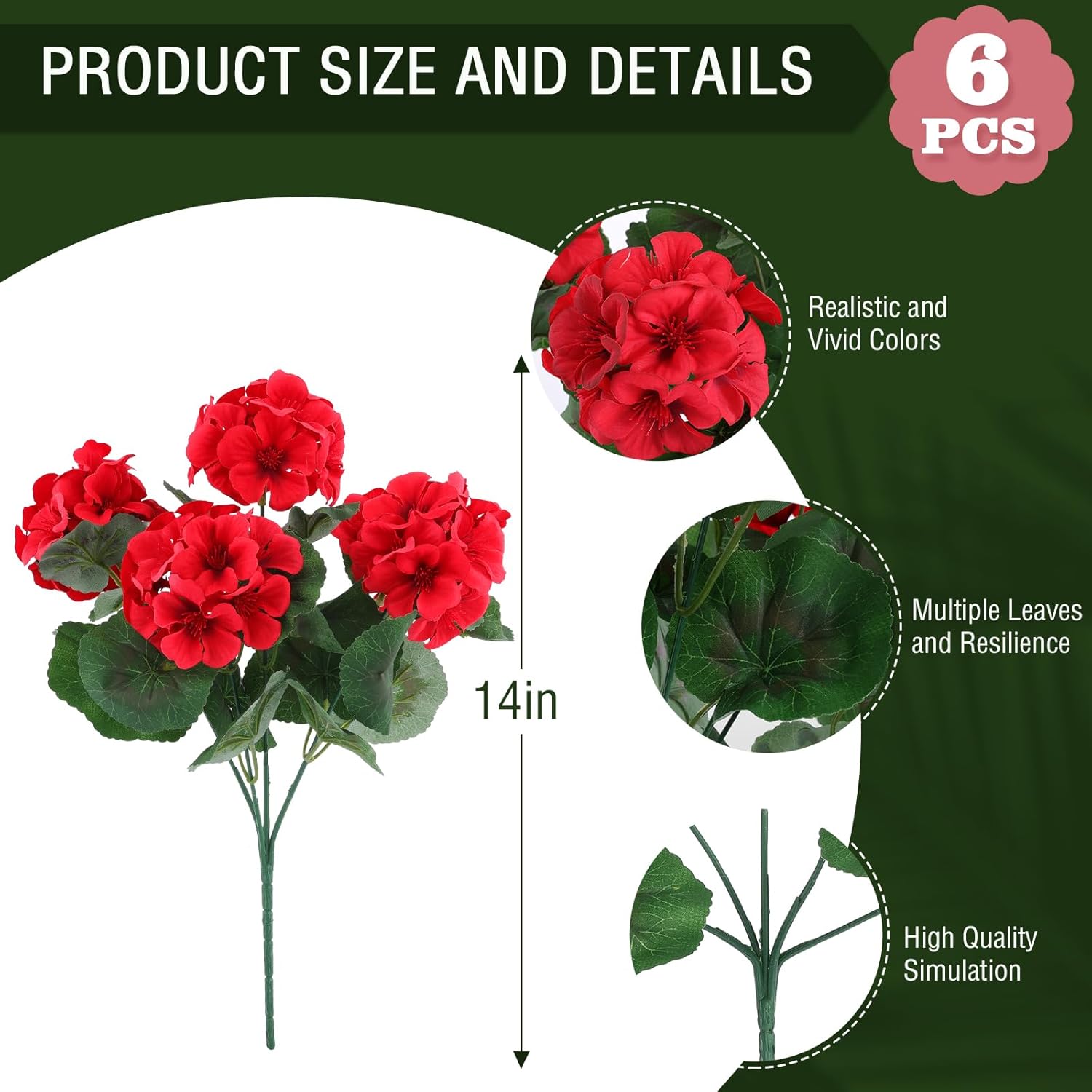
Silk geraniums — artificial flowers made to look like the red, pink, or white blooms you see spilling out of window boxes and front-porch planters every summer — have gotten genuinely good in the last few years. If you haven’t looked at faux botanicals lately, the short version is this: better manufacturing processes mean that the best products now hold up in outdoor conditions far longer than older generations of plastic flowers, and some are convincing enough to fool neighbors at five feet. This guide is written for buyers who already know they want faux geraniums for an outdoor planter (balcony, entryway, or hospitality display) and need to make a smart product decision rather than just buy the first thing that shows up in search results. We’ll cover how to spot a realistic-looking stem from a product photo alone, how to run the stem-count math for common planter sizes, and — the big one — how to honestly evaluate UV-resistance claims so you’re not replacing your display every eight weeks.
How to Read a Silk Geranium’s Realism Markers from a Product Listing
When you’re buying faux geraniums for an outdoor planter, you’re working under a specific constraint that indoor arrangements don’t share: viewers will see these at close range, in bright natural light, from multiple angles, repeatedly over weeks and months. That raises the bar considerably.
Here are the markers that separate convincing stems from obviously artificial ones, and how to find them in a listing without touching the product:
Petal texture and layering. Real geranium florets (the individual small flowers that make up the round cluster) have a slightly crepe-textured surface and sit in overlapping layers. In product descriptions, look for terms like “real-touch,” “polysilk,” or “velvet-touch petals.” These indicate a manufacturing step that adds surface dimension rather than leaving petals flat and shiny. Glossy or uniform-sheen petals read as plastic in daylight — this is the most common realism failure in budget stems. The Spruce’s roundup of best artificial outdoor plants specifically flags petal sheen as the differentiator between stems that read as silk versus stems that read as plastic at close range.
Leaf veining and color graduation. Geranium leaves are distinctive: scalloped edges, a slightly darker concentric ring pattern, and a matte surface with visible veining. In product photos, zoom into any leaf shot and look for visible vein lines and two-tone coloration (lighter green toward the center, darker at the margins). Listings that show only floret shots and hide the leaves are a flag — leaves are the hardest part to fake well and brands know it.
Stem wrapping and branching. A single geranium stem in nature branches into multiple floret heads with leaves at each node. Quality faux stems replicate this by wrapping the central stem in a fabric or paper-over-wire material rather than leaving bare green plastic. Listings that describe “wrapped wire stems” or “fabric-covered stems” consistently get better realism reviews. Apartment Therapy’s styling guide notes that stem texture and branch naturalism are what separate a convincing arrangement from one that reads as “craft store.”
Floret cluster density. Real geranium flower heads pack 15–30 individual florets into a tight dome. Sparse clusters — common in lower-price stems — leave gaps that read as fake immediately in sunlight. Check listing photos for density, and read Q&A sections where buyers often ask directly: “Do the flower heads look full?” The aggregate answer pattern is more useful than a single review.
Stem-Count Math for Common Planter Sizes
This is the calculation most buyers skip, and it’s why a lot of outdoor planter arrangements look thin. Geraniums in real life are planted densely — a 12-inch window box might hold four to six plants. Each plant produces multiple stems. To replicate that fullness with faux stems, you need more than you think.
The baseline formula: Measure your planter’s diameter (or, for rectangular planters, estimate the visual “face width” that will be most visible). For every 4 inches of face width, plan on 2–3 stems minimum for a natural-looking fill. For a showroom or hospitality install where the display will be evaluated at arm’s length, increase that to 3–4 stems per 4 inches.
By the numbers:
| Planter Width | Natural-Looking Fill | High-Density / Pro Display |
|---|---|---|
| 10 inches | 5–7 stems | 8–10 stems |
| 14 inches | 7–10 stems | 11–14 stems |
| 20 inches | 10–15 stems | 16–20 stems |
| 30-inch window box | 15–22 stems | 23–30 stems |
A few caveats on these numbers: they assume a standard faux geranium stem with one primary floret head and 2–3 leaf branches, roughly 12–16 inches tall. If you’re using stems with multiple floret heads (some premium stems branch into 2–3 clusters), you can reduce stem count by about 25%. If your stems are short or have sparse leaves, bump the count up.
For hospitality buyers outfitting multiple identical planters — hotel entrances, restaurant patios, event terraces — the consistent-count discipline also matters for visual uniformity. House Beautiful’s artificial plant coverage points out that mismatched density across repeated planter units is one of the first things that signals “faux” to trained eyes in a hospitality setting.
Don’t forget filler. Real geranium planters usually include trailing ivy, bacopa, or sweet potato vine at the edges. Faux versions benefit from the same layering: 2–3 trailing ivy or cascading greenery stems per planter soften the silhouette and help disguise the foam or floral wire anchoring the geranium stems in place.
The UV Longevity Trade-Off: What the Claims Actually Mean
This is the decision that has the biggest long-term cost implication, and it’s where marketing language is least standardized.
What “UV-resistant” means in practice. Almost every outdoor faux plant listing uses the phrase. In reality, it covers a wide range of actual performance. At the low end, it means the dye was treated with a basic UV stabilizer that will slow fading — you’ll see significant color loss in 2–3 months of full-sun exposure in a warm climate. At the high end (UV-stabilized PE or polyethylene construction with colorfast dyes baked into the material rather than surface-printed), reviewers consistently report 12–24 months before noticeable fading in comparable conditions.
The material tells you more than the claim:
-
Standard silk or polysilk stems (fabric petals over wire): These are not genuinely outdoor-rated, regardless of how they’re marketed. UV exposure degrades the fabric quickly, and moisture accelerates it. Good Housekeeping’s artificial plant guide notes that silk-construction stems are best reserved for covered porches and pergolas with indirect light, not direct sun exposure.
-
PE (polyethylene) construction: This is the material used in high-quality artificial hedges and topiary, and it’s now appearing in better faux floral stems. Colorfast PE holds up meaningfully better in direct sun. The trade-off is that PE petals have a firmer, slightly more uniform texture that some buyers find less convincing up close — though at planter-viewing distance (3–5 feet), it’s generally not an issue.
-
Real-touch latex or TPR coatings: Some premium stems use a rubber-like coating over the petal that adds texture and some UV durability. These tend to perform better than plain silk but worse than full PE in extended sun exposure. They’re also more expensive and can yellow in extreme heat climates.
The honest cost-per-season math. If you’re buying a 14-inch planter display with 10 stems:
- Budget silk stems at $3–5/stem: ~$30–50 initial cost, likely full replacement at the 8–10 week mark in direct sun = $90–150/season
- Mid-tier UV-stabilized mixed construction at $8–12/stem: ~$80–120 initial cost, reviewers in warm-climate markets report 12–18 months before replacement = $80–120/1–1.5 seasons
- Premium PE or treated stems at $15–25/stem: ~$150–250 initial cost, with reported longevity of 2+ seasons in direct sun = best cost-per-season outcome for permanent or semi-permanent installs
For event or seasonal use — a wedding terrace, a pop-up retail display, a holiday install — the budget silk option is often the smarter buy. For a hotel entrance or a residential installation where the expectation is set-and-maintain-for-a-year, the math tilts hard toward premium UV-rated construction.
Decision Rules: Matching Product Choice to Use Case
Here’s where to land based on your actual situation:
If you’re outfitting a covered porch, pergola, or shaded balcony: Direct UV is not your primary concern. Prioritize realism markers — petal texture, leaf detail, stem wrapping — over UV rating. A high-quality polysilk stem at $10–15 will look better up close than a PE stem at the same price. Moisture resistance matters here too; look for stems with sealed wire cores or plastic-core stems to prevent rust bleed onto your planter surface.
If you’re filling planters in full sun, permanent or semi-permanent install: Prioritize UV-rated PE construction, even if the petal texture is slightly less convincing than silk. Use the stem-count formula aggressively — fuller arrangements read as more natural and disguise any texture shortcomings. Factor in the full-season replacement cost before choosing budget options.
If this is an event or seasonal display (8 weeks or less): Budget polysilk stems are the correct choice. Spend the savings on stem count — buy 30% more stems than your baseline formula suggests and the density payoff in photos and at viewing distance will outperform a sparse premium display every time.
If you’re a hospitality or commercial buyer maintaining multiple identical units: Standardize on a single SKU, buy in volume for unit-price reduction, and document your reorder cycle. Mid-tier UV-stabilized stems with consistent colorway are almost always the right call — they balance longevity with manageable replacement cost and ensure visual uniformity across units. Aggregated reviewer patterns on platforms where commercial buyers leave detailed feedback consistently show that the 18-month replacement cycle at mid-tier pricing beats both the 8-week budget cycle and the 3-year premium cycle when factoring in the labor cost of swap-outs.
The faux geranium category has matured enough that there are genuinely good options at every price tier — the mistake is buying the wrong tier for your specific exposure conditions and maintenance cadence. Match the material to the environment first, then optimize for realism within that constraint, and your stem-count math will do the rest.